
Sculptures
Discover the Gardens’ sculpture collection installed across the vast landscape.
Last updated on 16 June 2026
The Singapore Botanic Gardens' landscapes form a living gallery for sculptures created from diverse materials by local and international artists. Many works have been generously donated and commemorate partnerships with nations, corporations, communities, and individuals, forming an important part of the Gardens' history.
Download trail maps (Map 1 from Tanglin Gate (opens in new tab), Map 2 from Bukit Timah Gate (opens in new tab)) to locate our sculptures, and scroll down to find out more about each one.
Tanglin Entrance
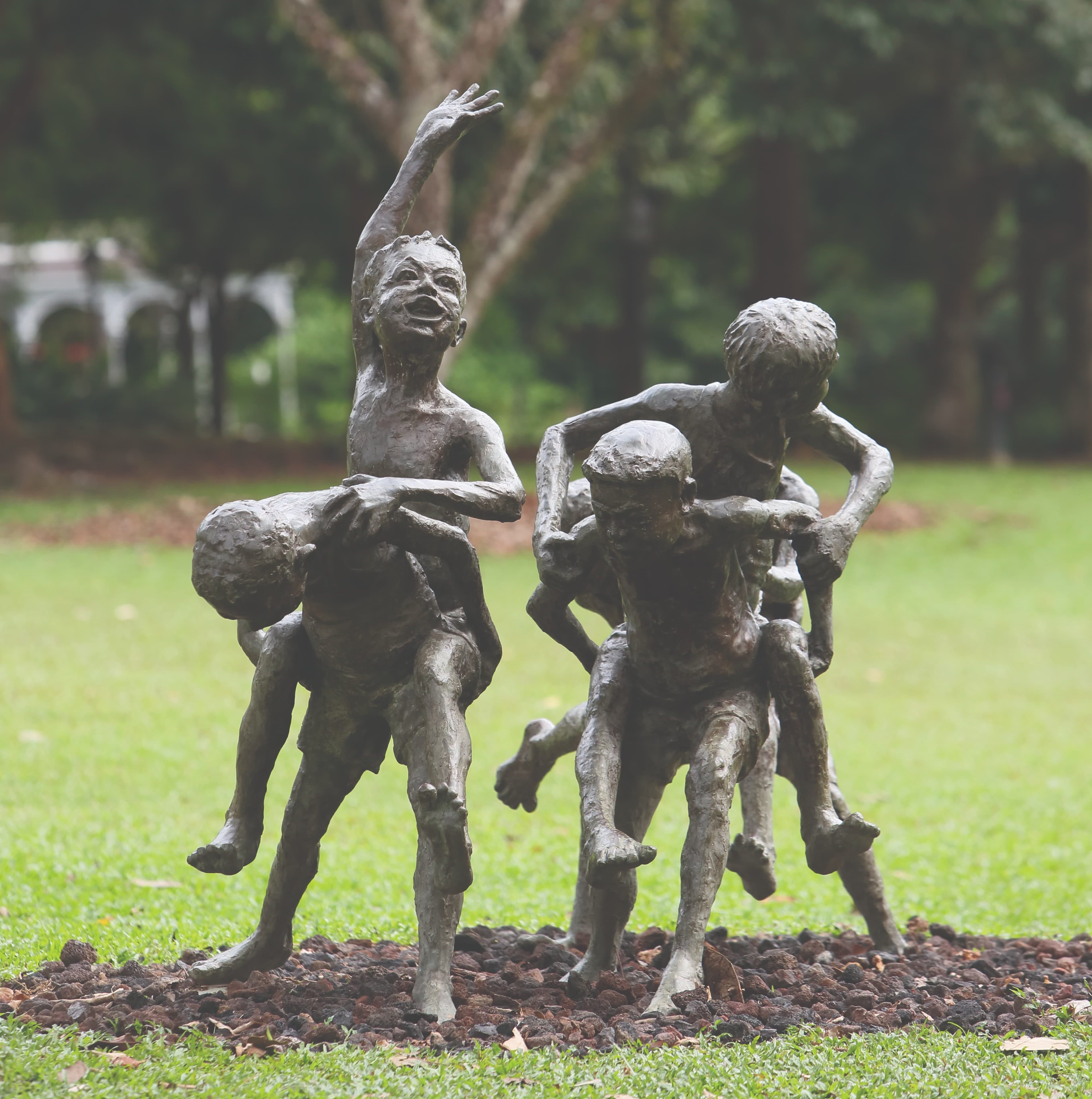
Chang Kuda
CHONG FAH CHEONG
bronze
Donated by Asia Pacific Breweries, 2011
Located on Lawn E
Chang Kuda portrays a group of six boys playing the childhood game by the same name, which is also known as encang kuda. Capturing the dynamic movement of the game, with well-crafted details showing the varied postures and facial expressions, this piece was sculpted by local self-taught pioneer artist and Cultural Medallion recipient Chong Fah Cheong. Chang Kuda is a nostalgic sculpture that encapsulates the simple joy and freedom of childhood.
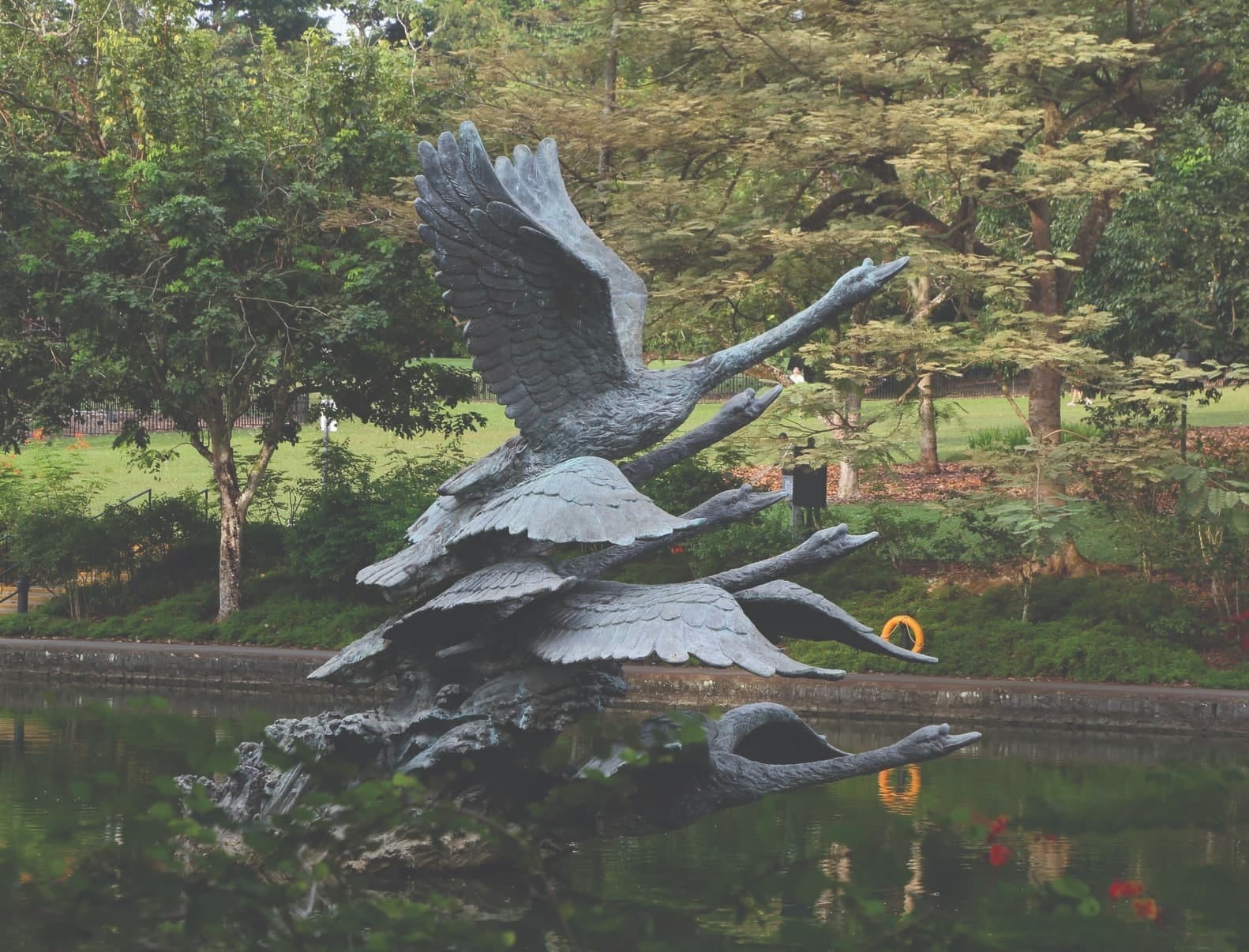
Flight of Swans
ENG SIAK LOY
bronze
Installed in 2006
Located at Swan Lake
Placed in the centre of the lake, the bronze swans in this work appear to be taking flight from the surface of the water.
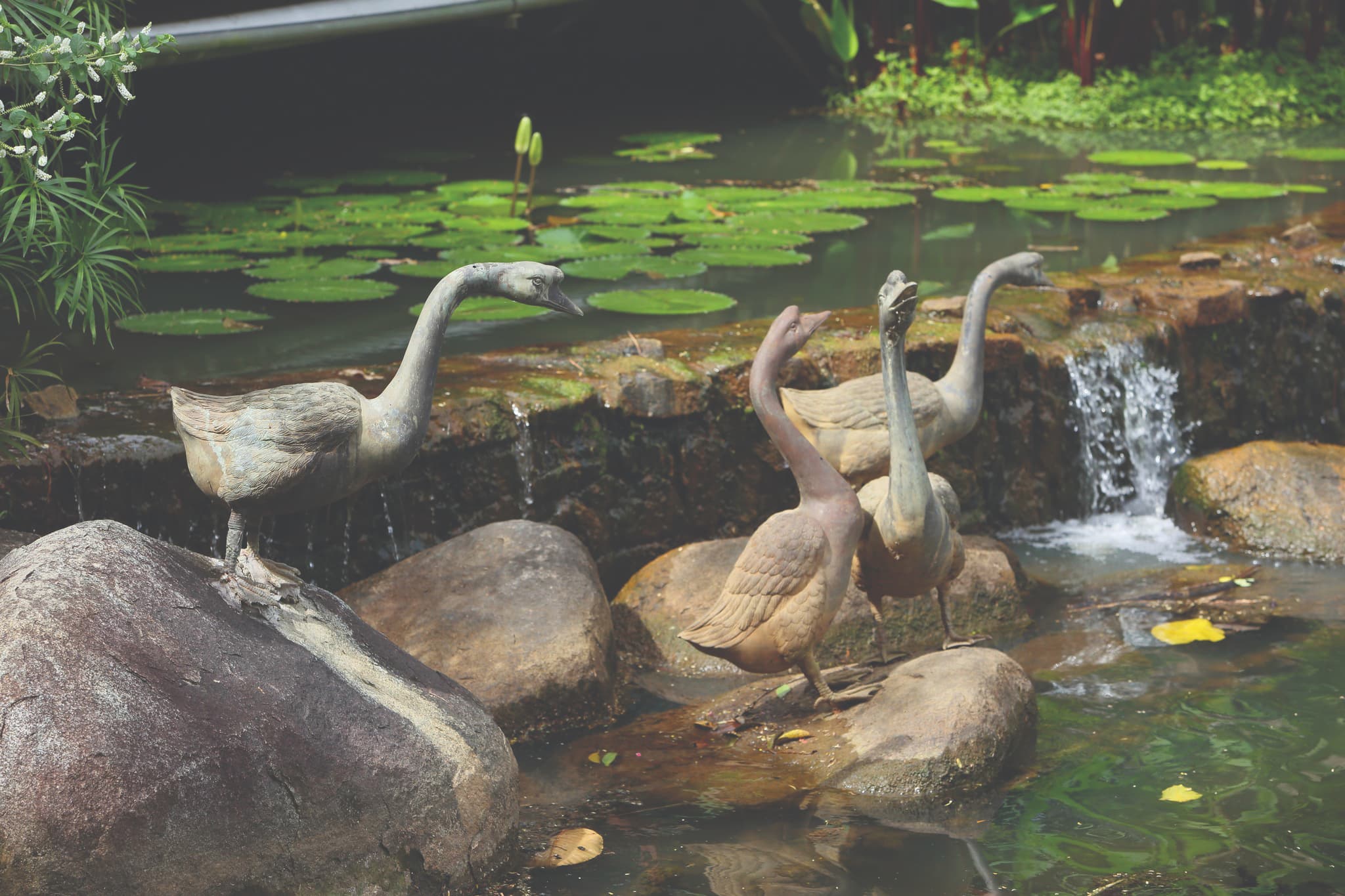
Geese
UNKNOWN ARTIST
Donated by Tan Jiew Hoe, 1995
Located at Swan Lake
Near The Dell at the northeastern end of Swan Lake, visitors can find this gaggle of Geese. When first donated in 1995, it was placed in front of Burkill Hall; it was gifted to the Gardens as a congratulatory piece at the opening of the National Orchid Garden. In 1996, it was relocated to Swan Lake.
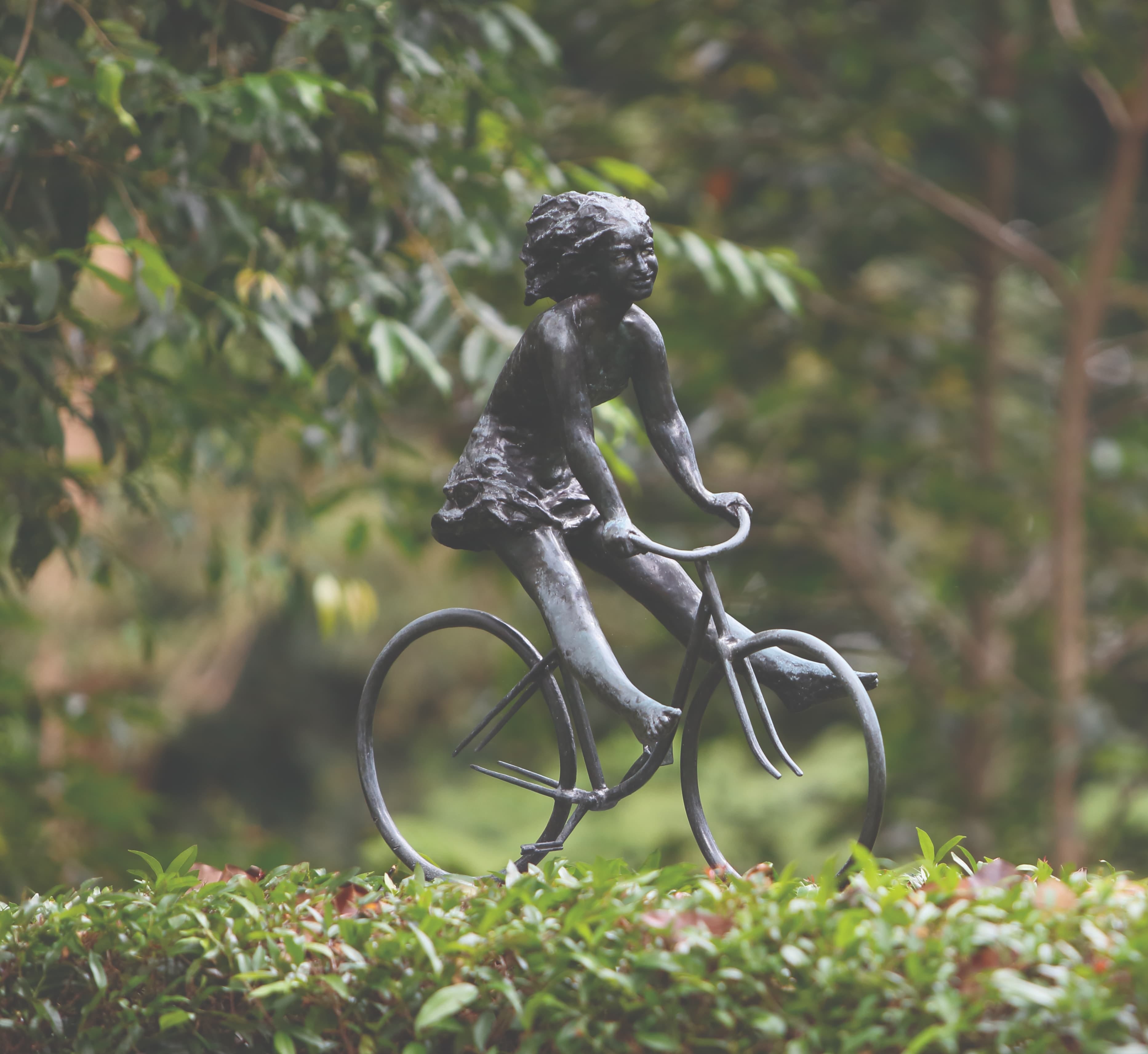
Girl on a Bicycle
SYDNEY HARPLEY
bronze with green patina
Donated by David Marshall, 1987
Located at the western end of Bandstand Hill
The Girl on a Bicycle has the same carefree spirit as Lady on a Hammock. With her legs lifted free of the pedals in joyful abandon, she wheels down the path of a spiralling hedge. The sculpture was donated in 1987 by David Marshall, who said the piece embodied what he wanted for the children of Singapore, and hoped that it symbolised the fun of living.
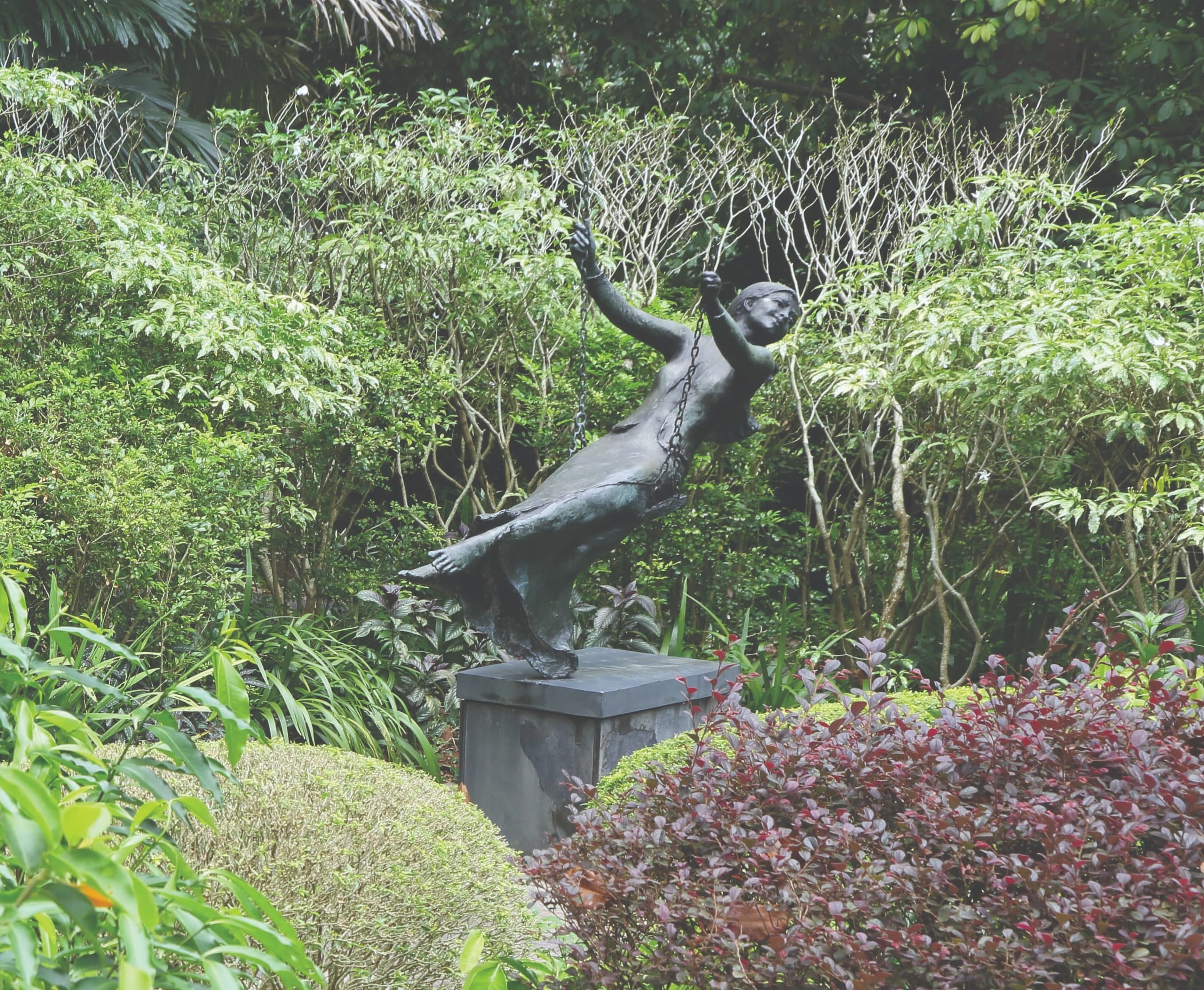
Girl on a Swing
SYDNEY HARPLEY
bronze with green patina
Donated by David Marshall, 1984
Located at the western end of Bandstand Hill
Girl on a Swing was the first of the three bronze sculptures donated to the Gardens by David Marshall. This life-size bronze sculpture was modelled after local Malay factory production operator Sapiah. The figure is mounted to give the impression that she is in mid-air. Here in the Gardens, she swings over a bed of brightly coloured flowering shrubs, creating an effect of great zest and freedom of movement.
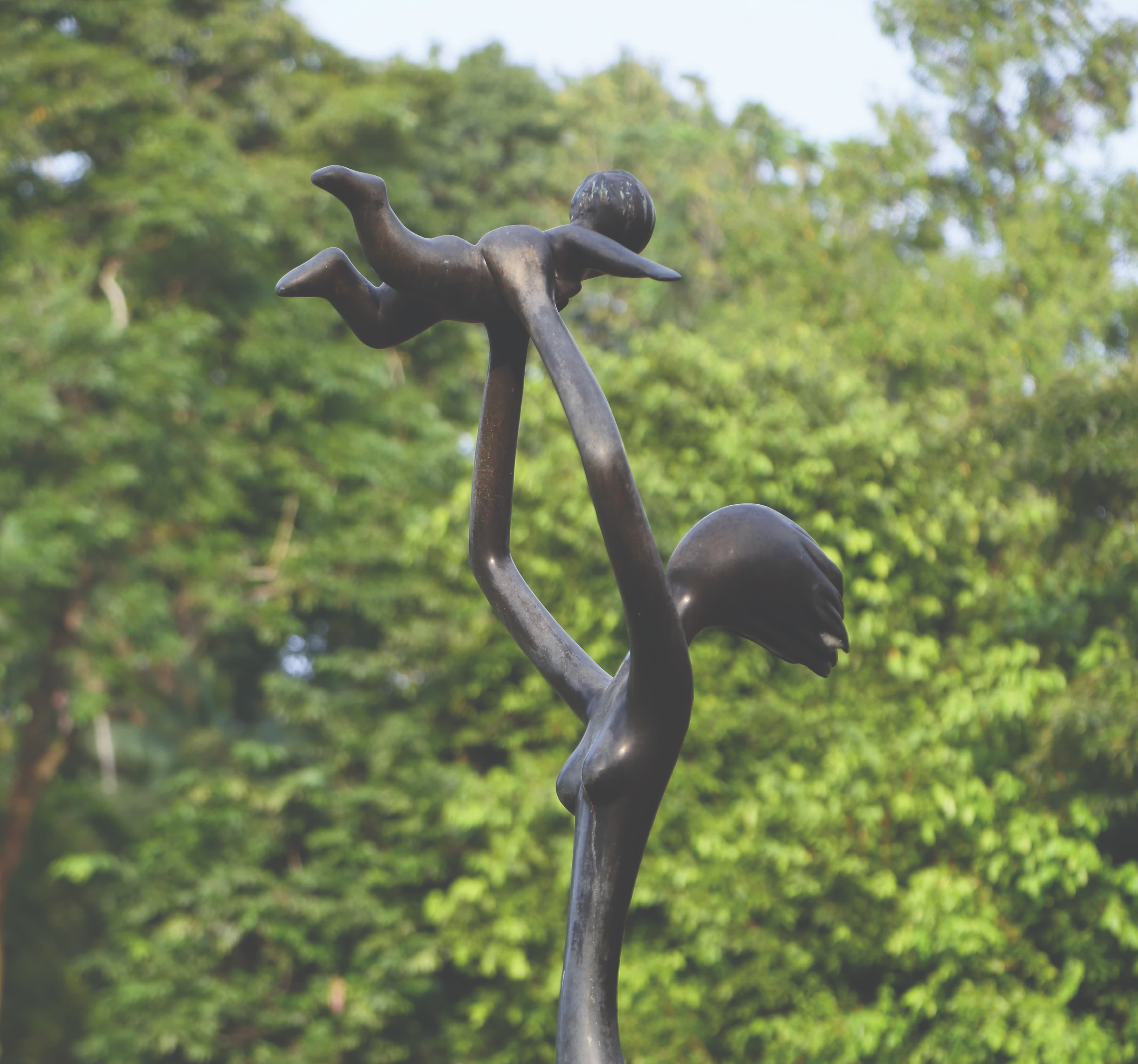
Joy
RUTH BLOCH
bronze
Donated by a Friend of the Gardens, 2005
Located on Lawn E
The smooth and elongated sculpture depicts a mother gazing with love at her child as she holds her high in the air. This tender moment, shared between a mother and her child, expresses the timeless and ineffable nature of love and the joys of motherhood.
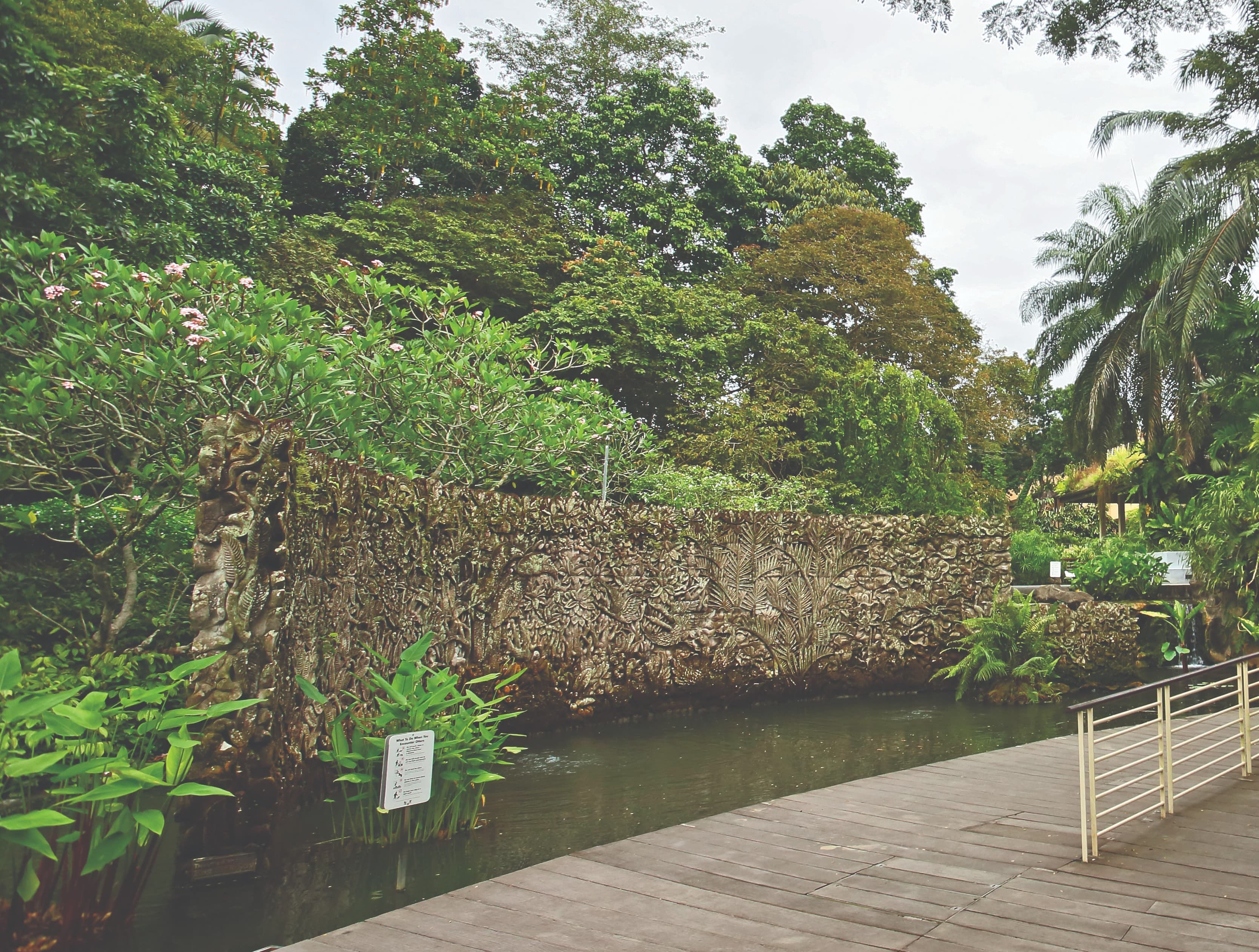
Koi Pond Mural
ENG SIAK LOY
Indonesian brexi stone
Installed in 2005
Located near the Tanglin Gate, at entry area into the Botany Centre
A massive mural composition of intricate details carved by 20 Balinese stone workers, depicting a variety of flora and fauna, including the symbol of the Singapore Botanic Gardens, the Sealing Wax Palm (Cyrtostachys renda). Spot other features such as various species of Plumeria, including the Chinese Egret (Egretta eulophotes), a rare migrant in Singapore, and the Oriental Pied Hornbill (Anthracoceros albirostris).
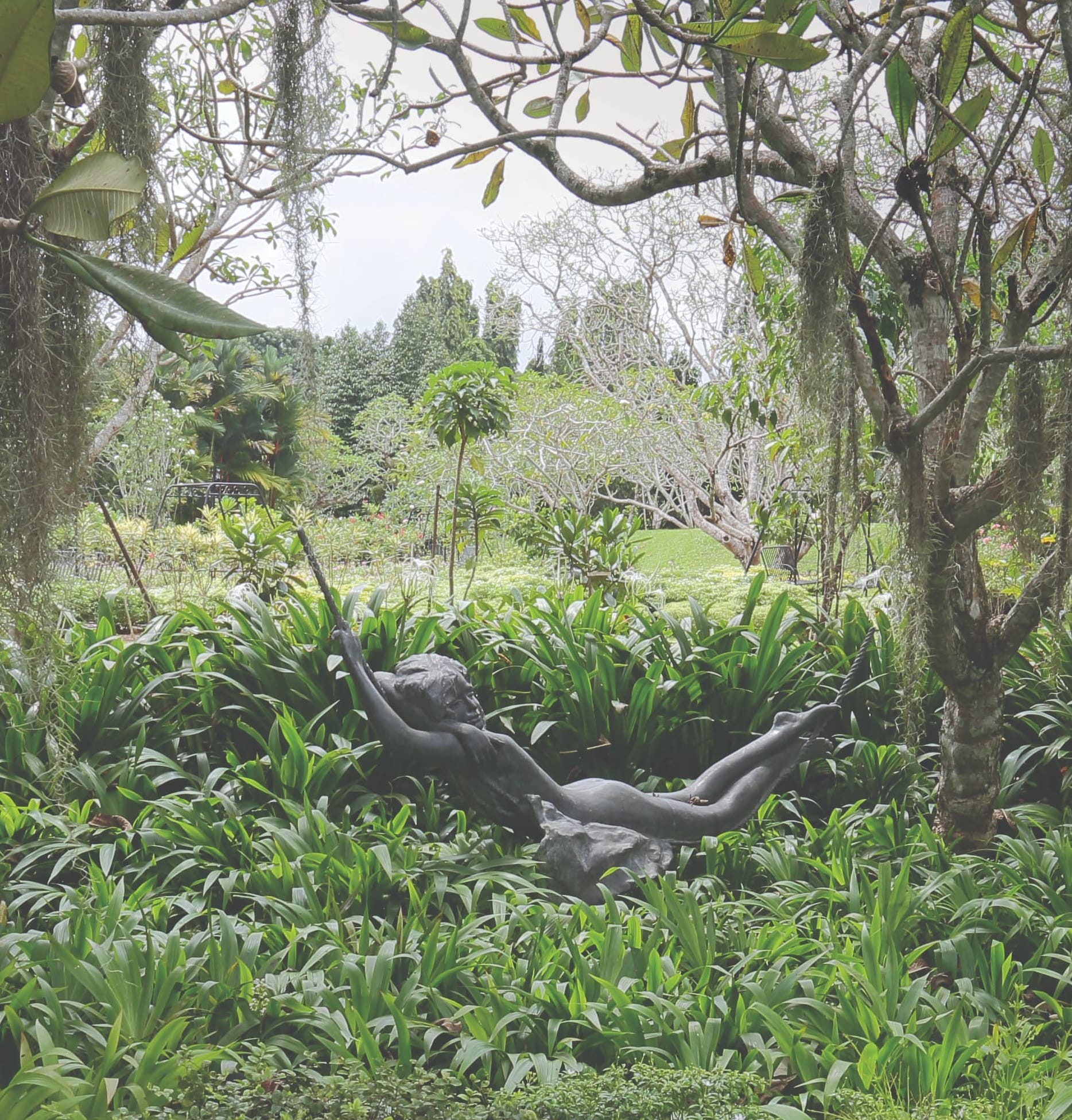
Lady on a Hammock
SYDNEY HARPLEY
bronze with dark brown patina
Donated by David Marshall, 1989
Located in the Frangipani Collection
The Lady on a Hammock depicts a maiden reclining in a hammock, a beautiful sight to behold especially when the surrounding plants are in full bloom. One of three sculptures in the Gardens commissioned by Singapore’s first Chief Minister David Marshall, Lady on a Hammock was a congratulatory gift for the Gardens’ 130th anniversary in 1989.
Today, it is surrounded by frangipanis artfully draped in Spanish Moss (Tillandsia usneoides), which sways with the slightest of winds and brings a sense of motion to the Lady on a Hammock.
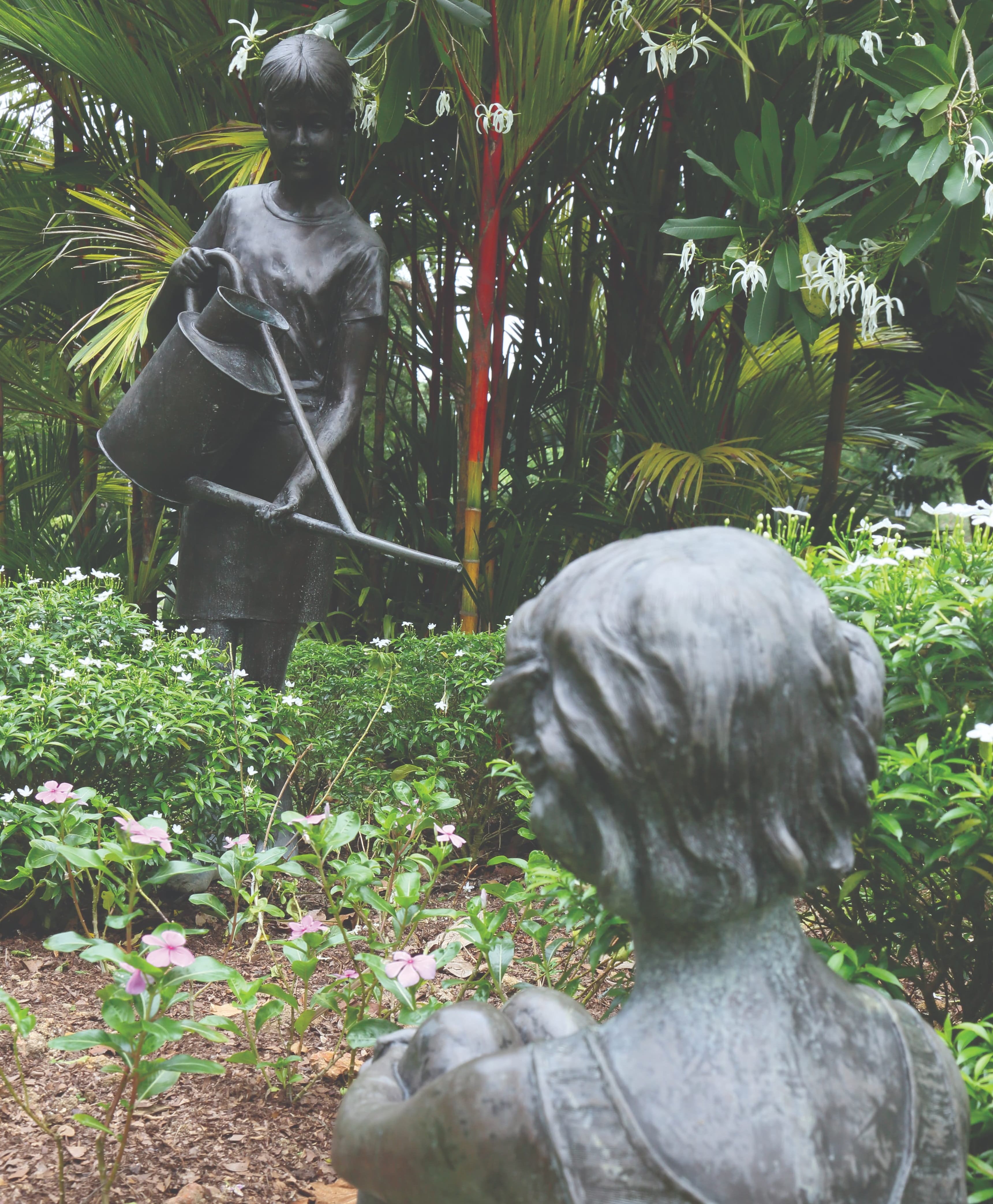
Nurturing
VANESSA MARSTON
bronze
Donated by Myrna and Ivy Thomas, 2011
Located in the Frangipani Collection
Nurturing was donated to the Gardens in 2011 by two sisters, Myrna and Ivy Thomas, in fond memory of their late mother, Doris. Sculpted by British artist Vanessa Marston, her bronze piece consists of two figures. It portrays a moment between a mother watering her plants and her child, seated on the ground and looking in her direction with an earnest gaze.
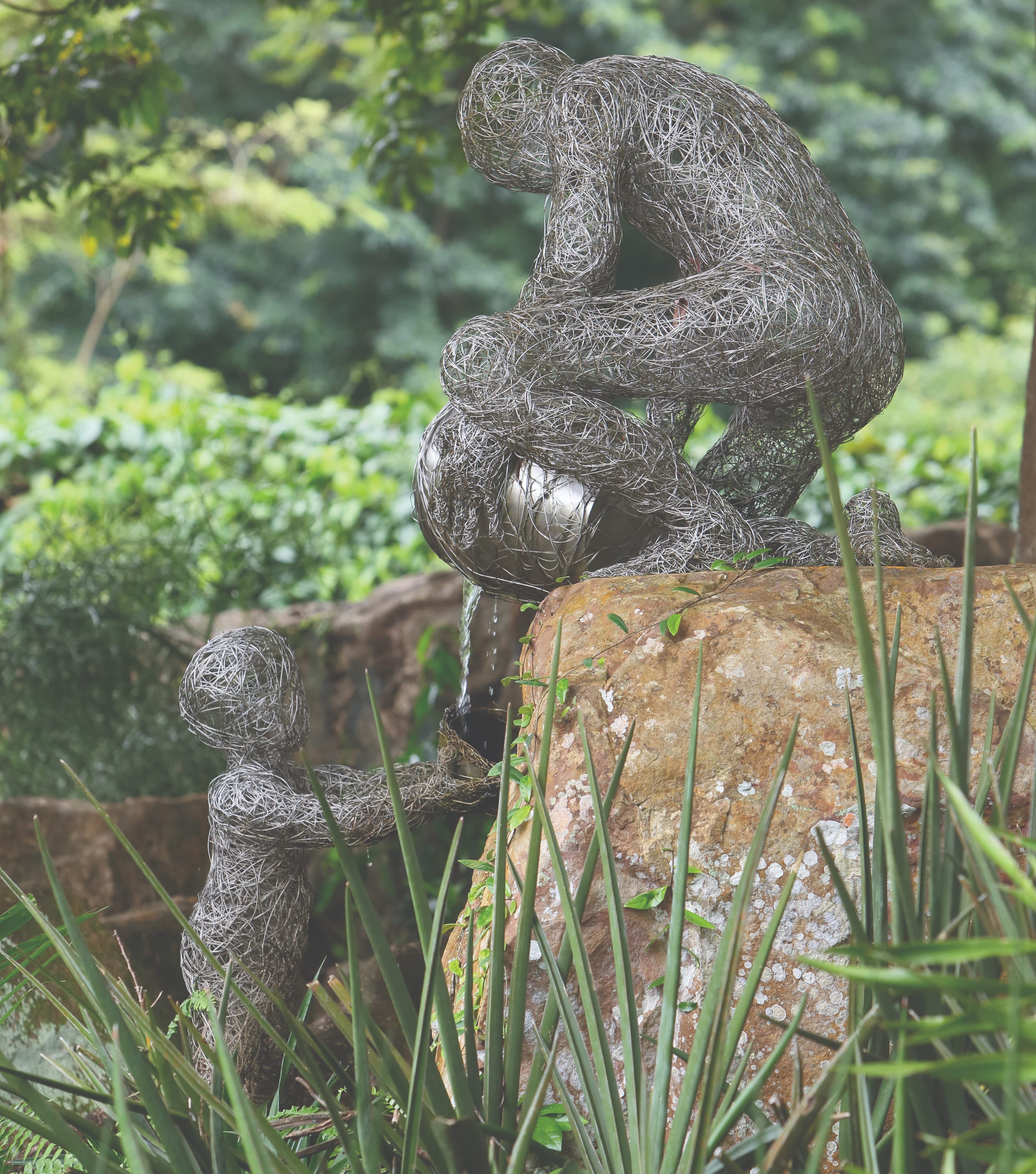
Passing of Knowledge
VICTOR TAN WEE TAR
stainless steel
Donated by the Rotary Club of Singapore and by Crocodile, 2003
Located at the eastern end of Bandstand Hill
Passing of Knowledge portrays a father and son with a continuous stream of water flowing between them, symbolising the knowledge that is passed from generation to generation.
It was sculpted by Singaporean artist Victor Tan Wee Tar, who has earned a reputation in the local art scene as a sculptor who works with the medium of wire.
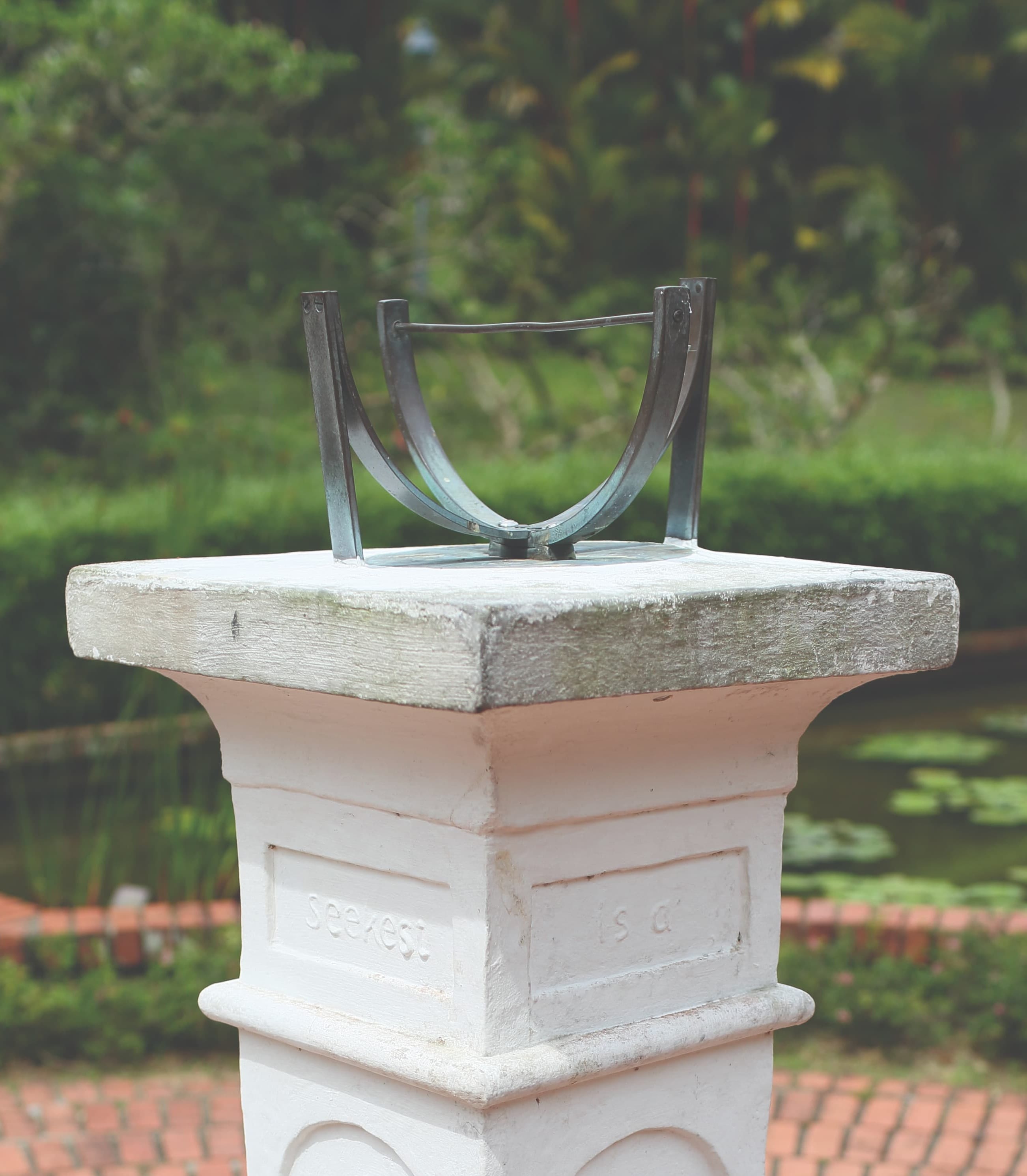
Sundial
URSULA HOLTTUM
metal and concrete
Installed in 1929
Located in the Sundial Garden
The Sundial was designed and sculpted by Ursula Holttum in 1929, the wife of then-director of the Gardens Eric Holttum. The sundial is elevated on a four-sided pedestal, with each side depicting a different carved figure. Two figures represent Father Time and Death, while the identities of a robed woman and a turbaned male holding a candle or lanterns are unknown. It is inscribed with the statement that “What thou seekest is but a shadow”.
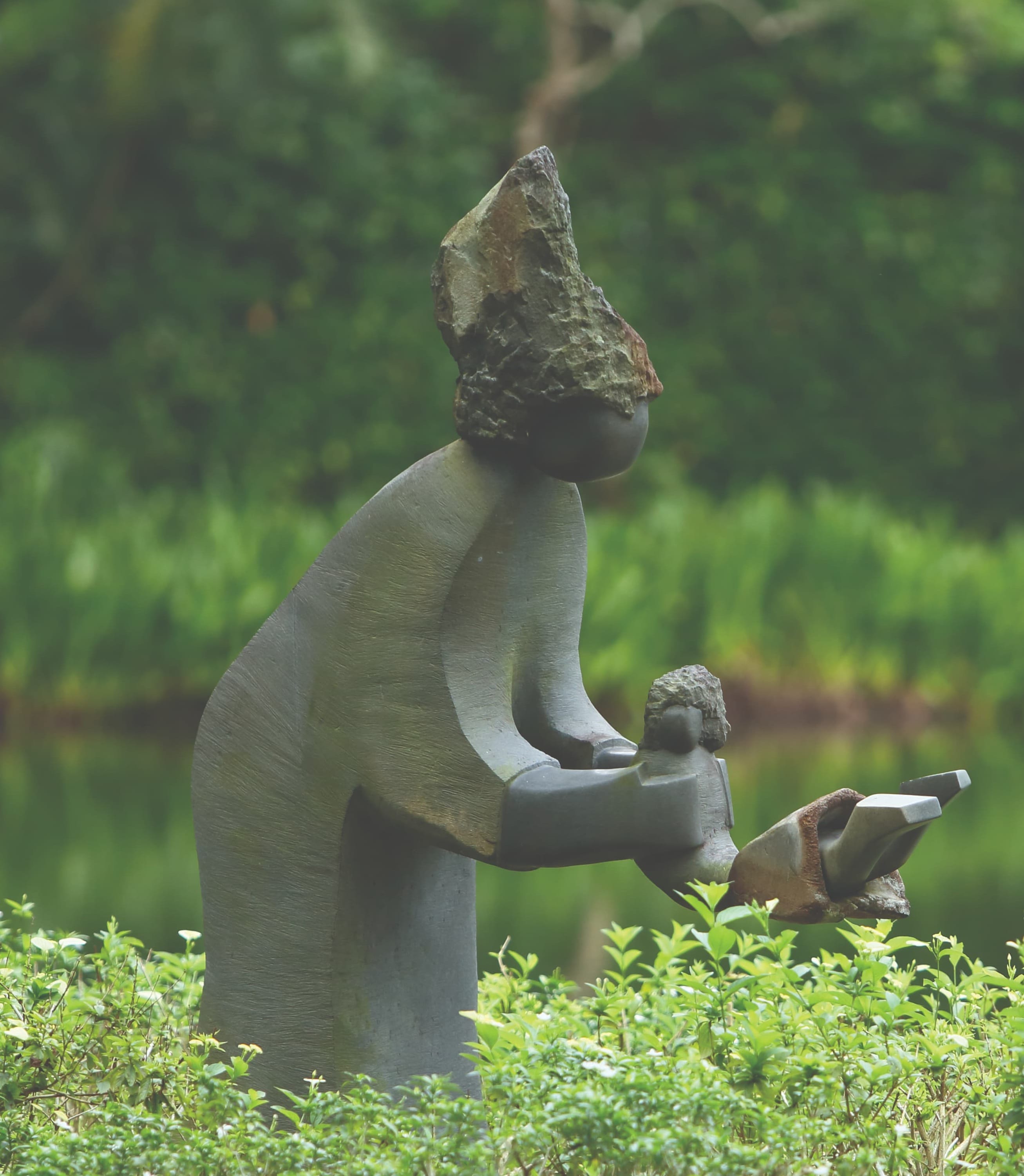
Swing Me Mama
DOMINIC BENHURA
springstone
Donated by the Rotary Club of Singapore, 1999
Located near the Victorian Gazebo at Swan Lake
The piece portrays a mother swinging her child, a scene inspired by the artist’s experience of playing with his own child.
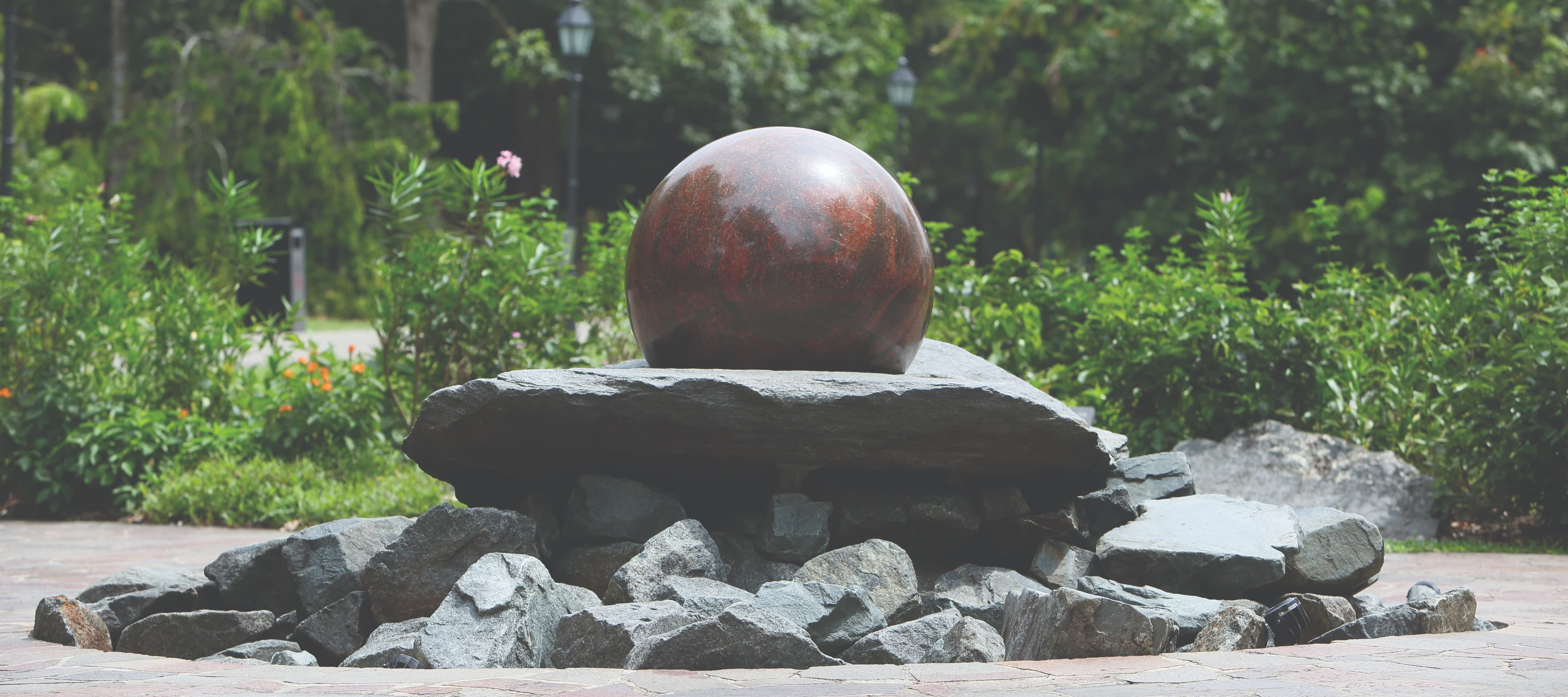
Swiss Granite Fountain
UELI FAUSCH
granite
Donated by the Swiss community in Singapore, 1991
Located at the junction of the Cissus Trellis, Lawn E and the Frangipani Collection.
The ball component took Swiss sculptor Ueli Fausch three months to sculpt by hand. It weighs 700 kg, fits perfectly into a 3-tonne basal block, and is kept afloat by strong water pressure directed through the block.
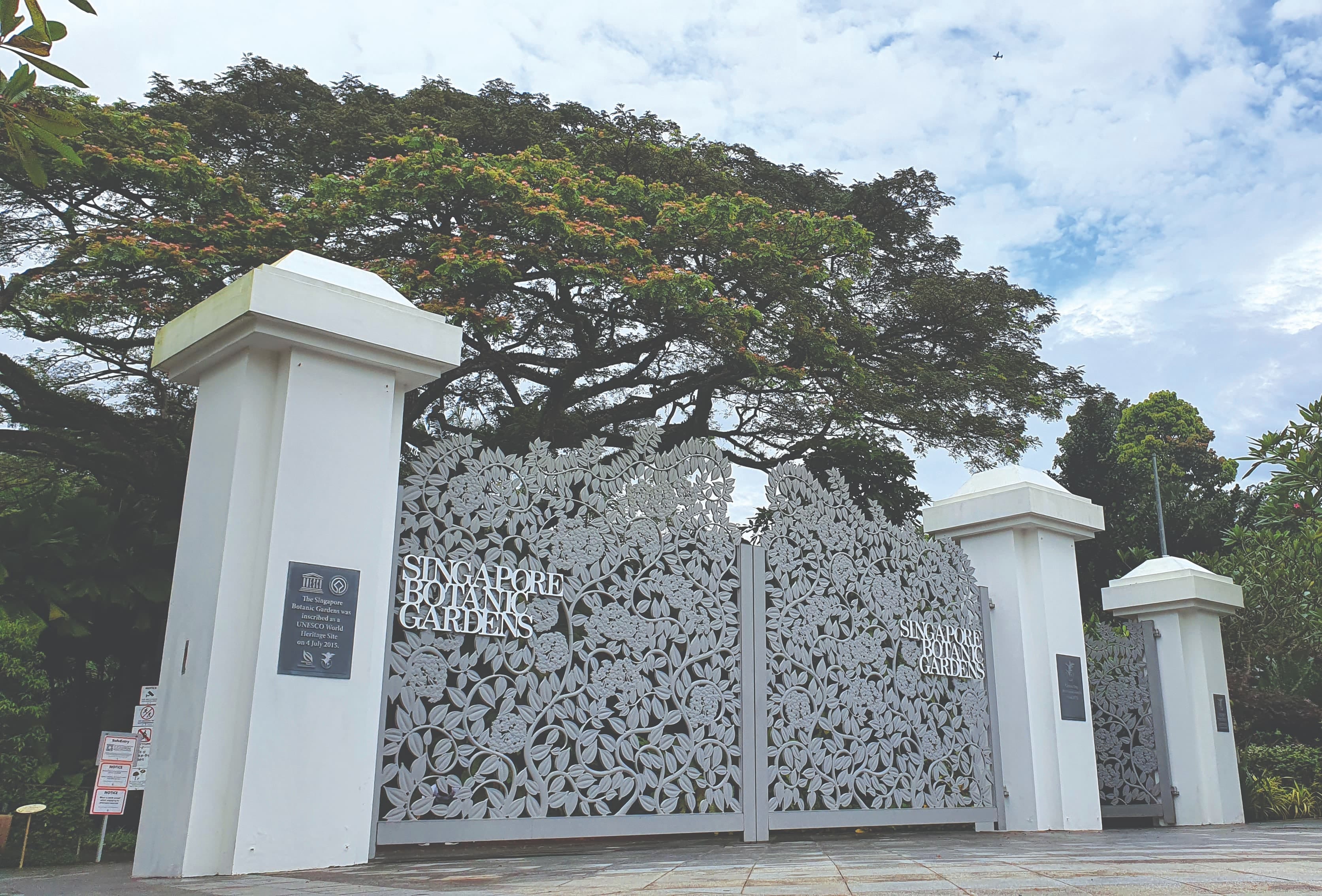
Tanglin Gate
ENG SIAK LOY
cast aluminium
Installed in 2006
Located at the Tanglin entrance
The metal gates of the Tanglin Gate entrance are embellished with motifs inspired by the woody climber, Phanera kockiana. Set against a backdrop of lush greenery, including a magnificent mature Rain Tree (Samanea saman), visitors who enter the Gardens through this sculptural piece are greeted by a complementary blend of nature and art.
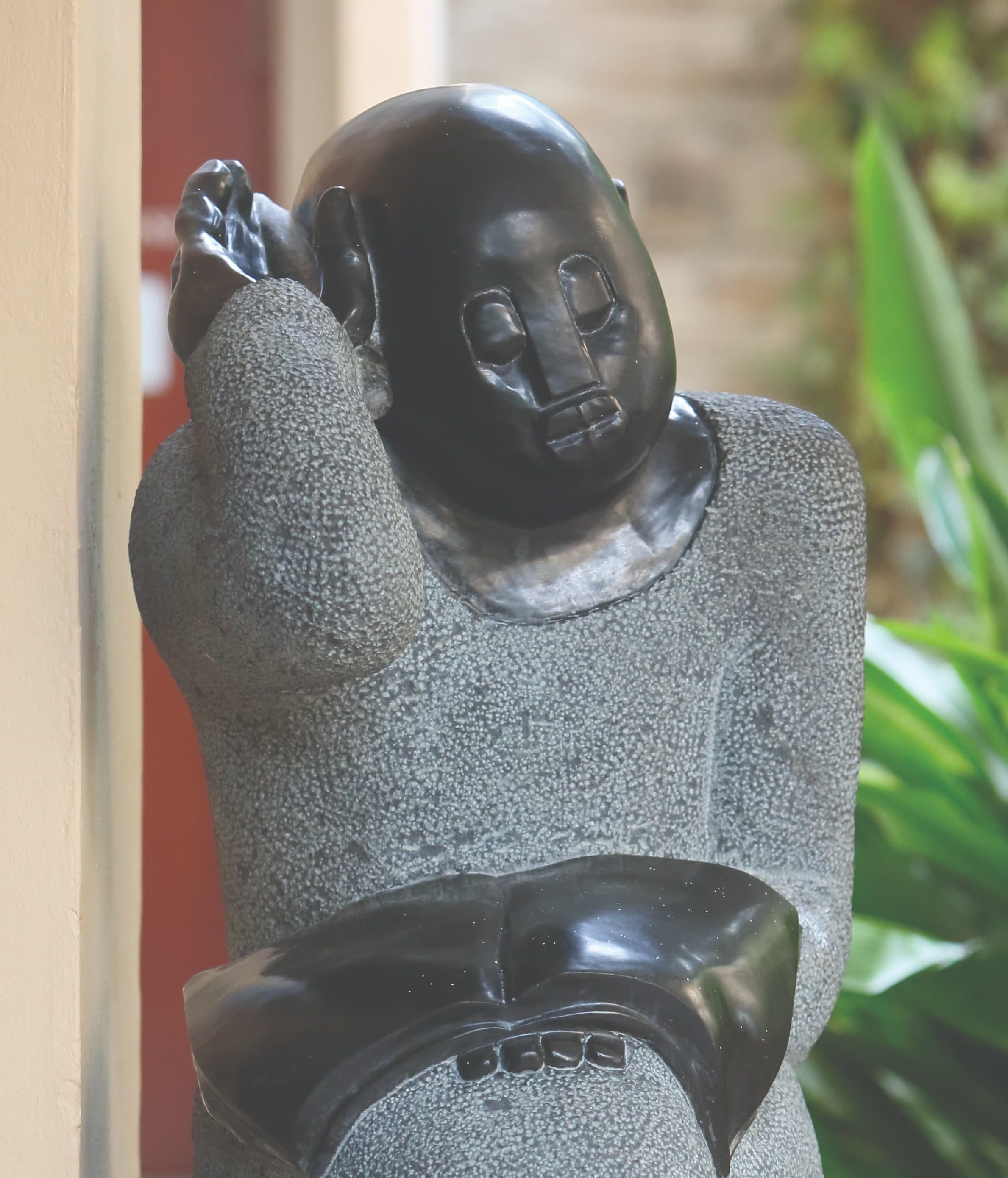
The Bookreader
JONATHAN MHONDOROHUMA
springstone
Installed in 2006
Located in front of the Library of Botany and Horticulture
Placed in a quiet spot outside of the Library of Botany and Horticulture, The Bookreader depicts a life-sized woman seated on a bench, enjoying her book in peace.
Tyersall-Gallop Core
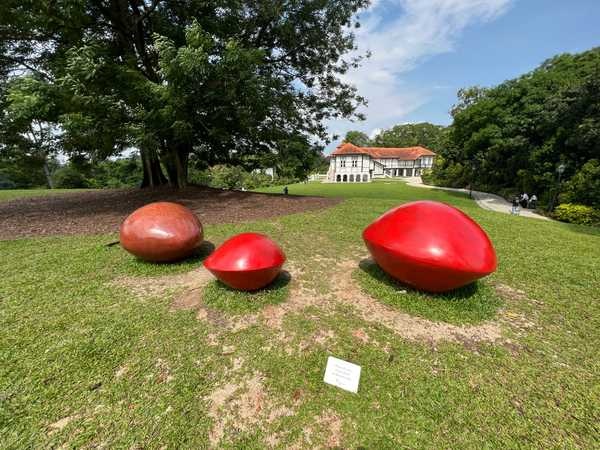
Biji Sayang
KUMARAI NAHAPPAN
silicon bronze
Installed in April 2022
Located at lawn of the Botanical Art Gallery (Gallop No.7)
An installation bringing together the family members of the Saga tree: the seeds of the Adenanthera pavonine and its close relative A. malayana. The seeds symbolise the promise of life.
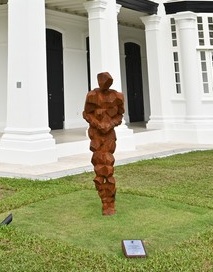
Contract
ANTONY GORMLEY
bronze
Donated by Hotel Properties Limited, 2020
Located at lawn of the Botanical Art Gallery (Gallop No.7)
Contract is a piece by British sculptor Antony Gormley and is part of a series of his polyhedral sculptures. The sculpture was gifted to the Singapore Botanic Gardens by Hotel Properties Limited in remembrance of their late Chairman, Mr Joseph Grimberg, a prominent lawyer and former Supreme Court judge.
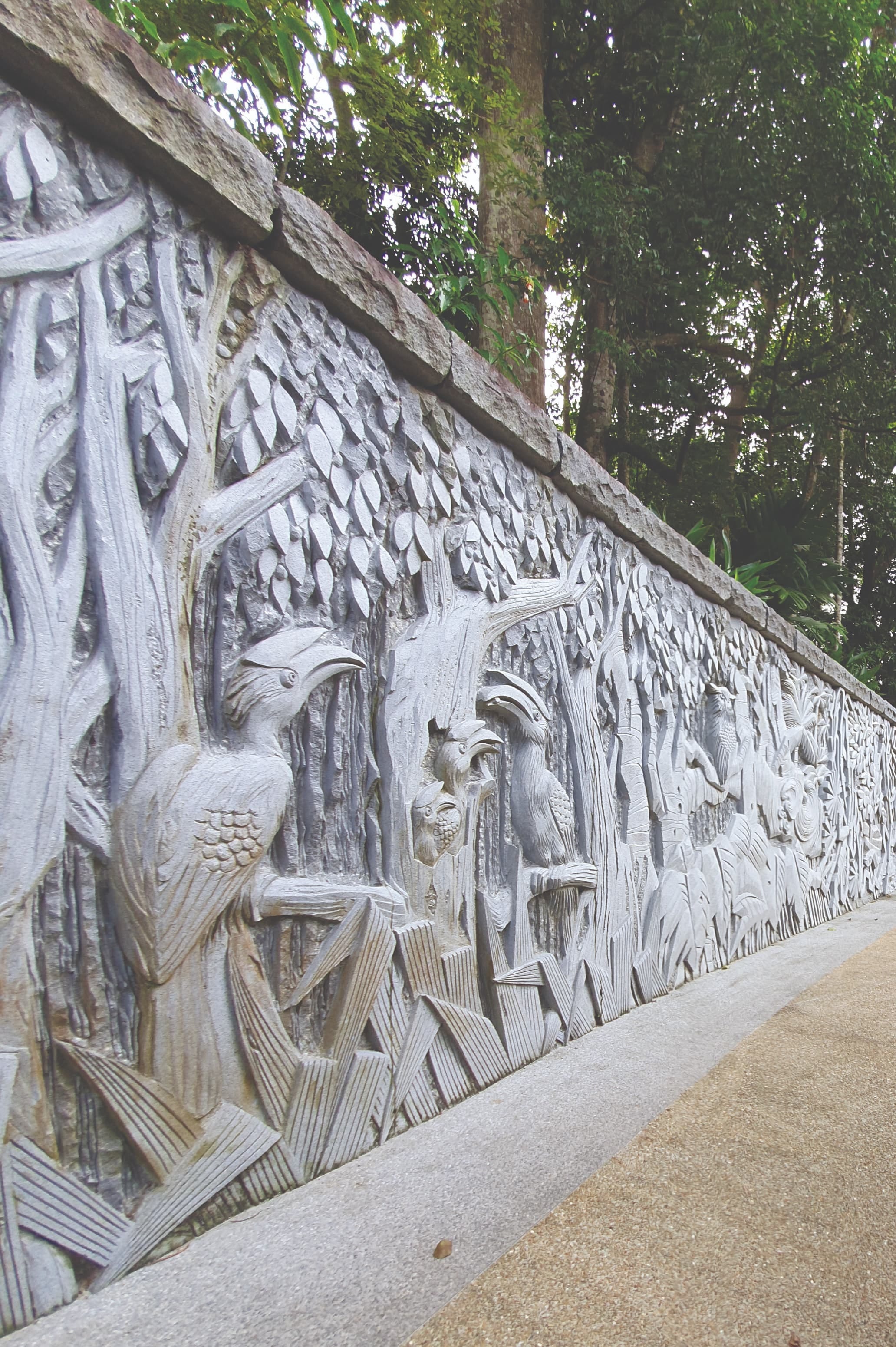
Our Rainforest Heritage Mural
ENG SIAK LOY
stone
Donated by Dr William Chan and Mrs Chan Tsok Fah, 2017
Located at the entrance to the Learning Forest
This stately wall sculpture was commissioned to celebrate rainforests, which are home to over half the world’s flora and fauna. It captures the incredibly rich biodiversity that can be found in rainforest habitats.
Central Core
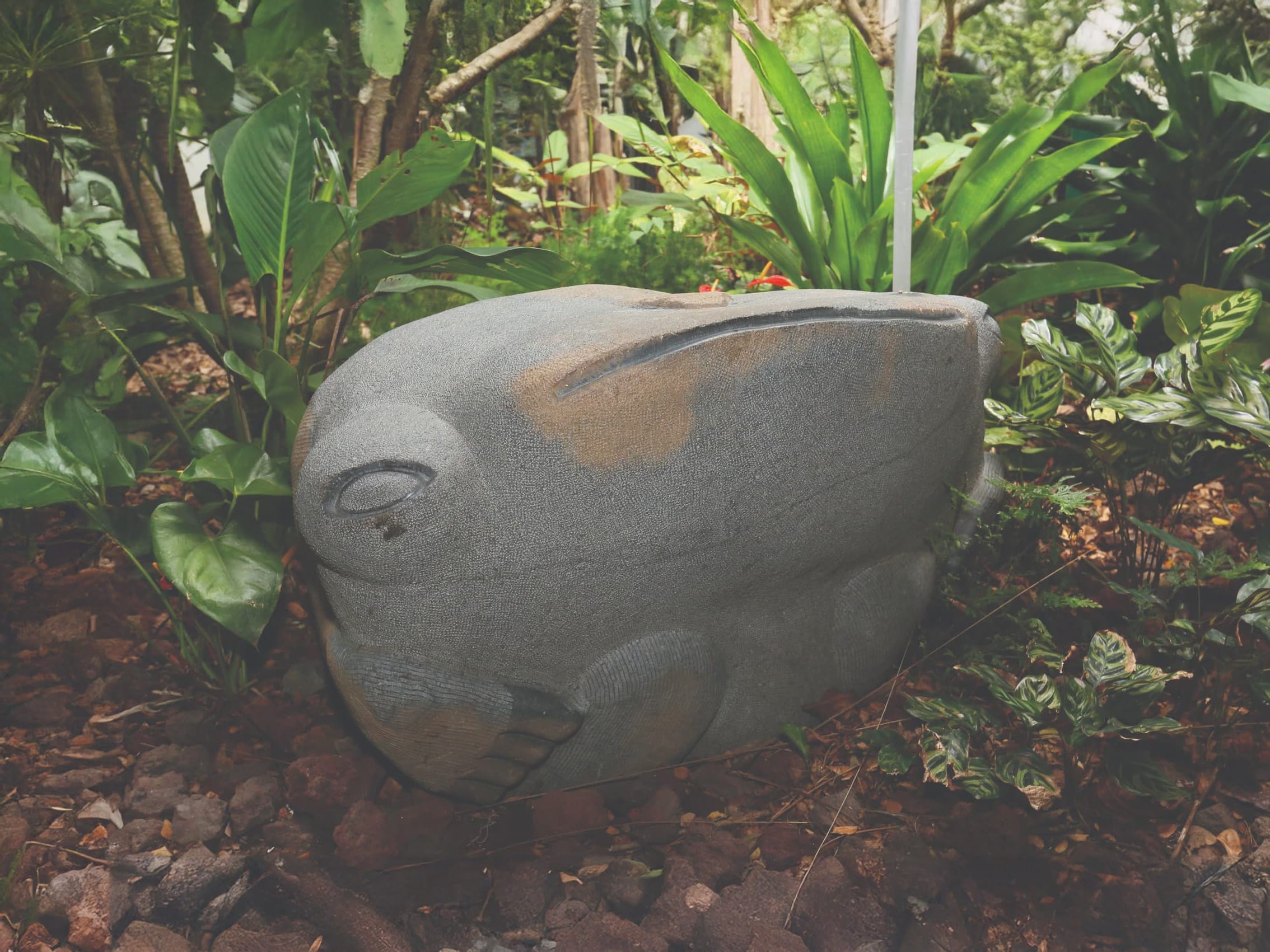
Bull Frog
JORAM MARIGA
springstone
Installed in 1992
Located at the Nassim Gate Visitor Centre
This sculpture was created by Zimbabwean artist Joram Mariga. Much of his work features subjects from nature, and is stylistically influenced by themes drawn from the culture of the Shona people.
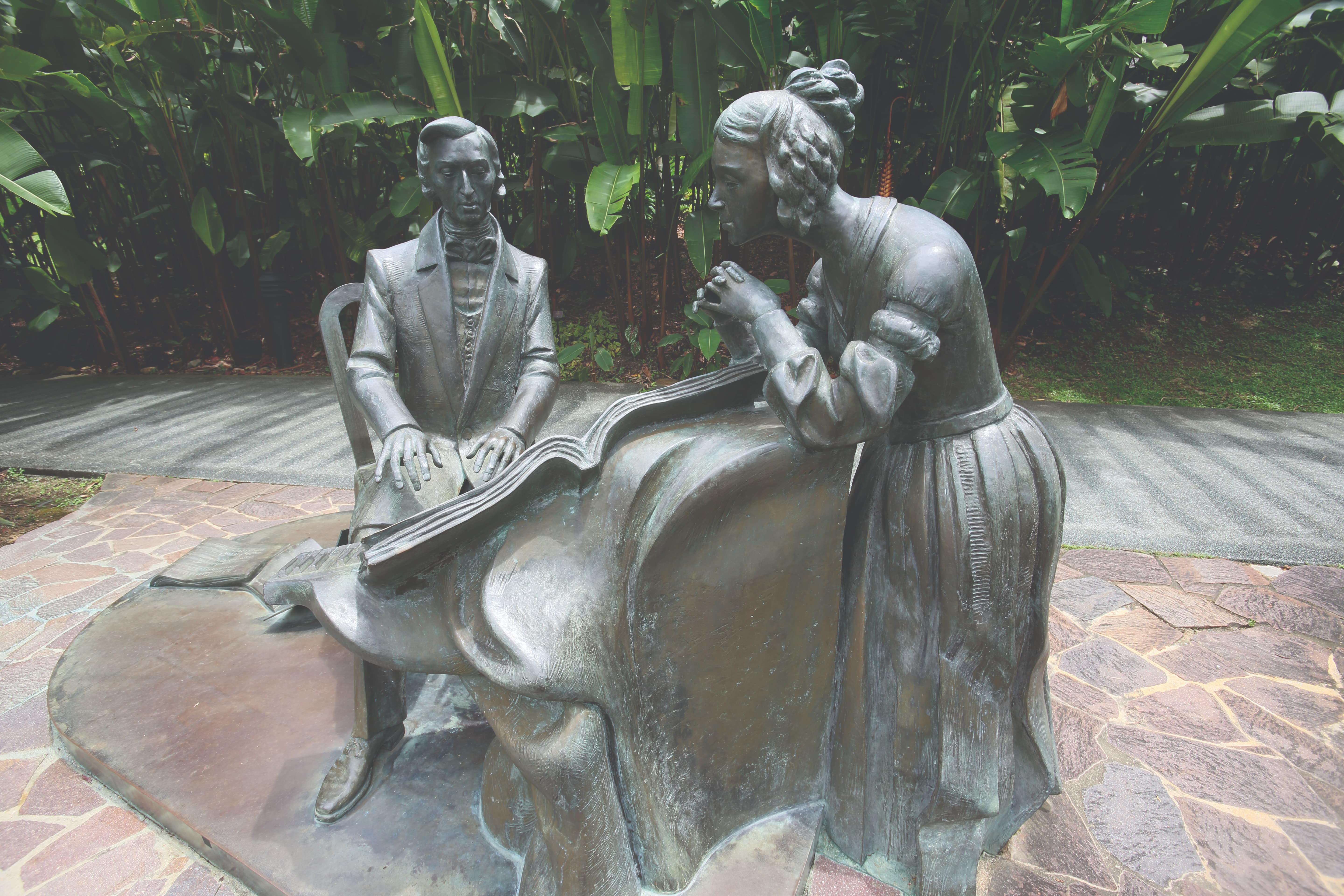
Chopin
KAROL BADYNA
bronze
Donated by the Embassy of the Republic of Poland in Singapore, with support from Halina and Miroslaw Pienkowski, 2008
Located along Heliconia Walk
This sculpture is a tribute to one of music’s greatest composers, Frédéric Chopin (1810 – 1849). Sculpted by Karol Badyna and made of bronze, the sculpture weighs a hefty half a tonne. It overlooks Palm Valley and the Shaw Foundation Symphony Stage, where orchestras play regularly for public audiences. The piece arrived at the Gardens two years ahead of the bicentenary of Chopin’s birth. Greatly moved by the sound of the piano from a young age, Chopin began formal training at the age of 7 and wrote the Polonaise in G minor that same year.
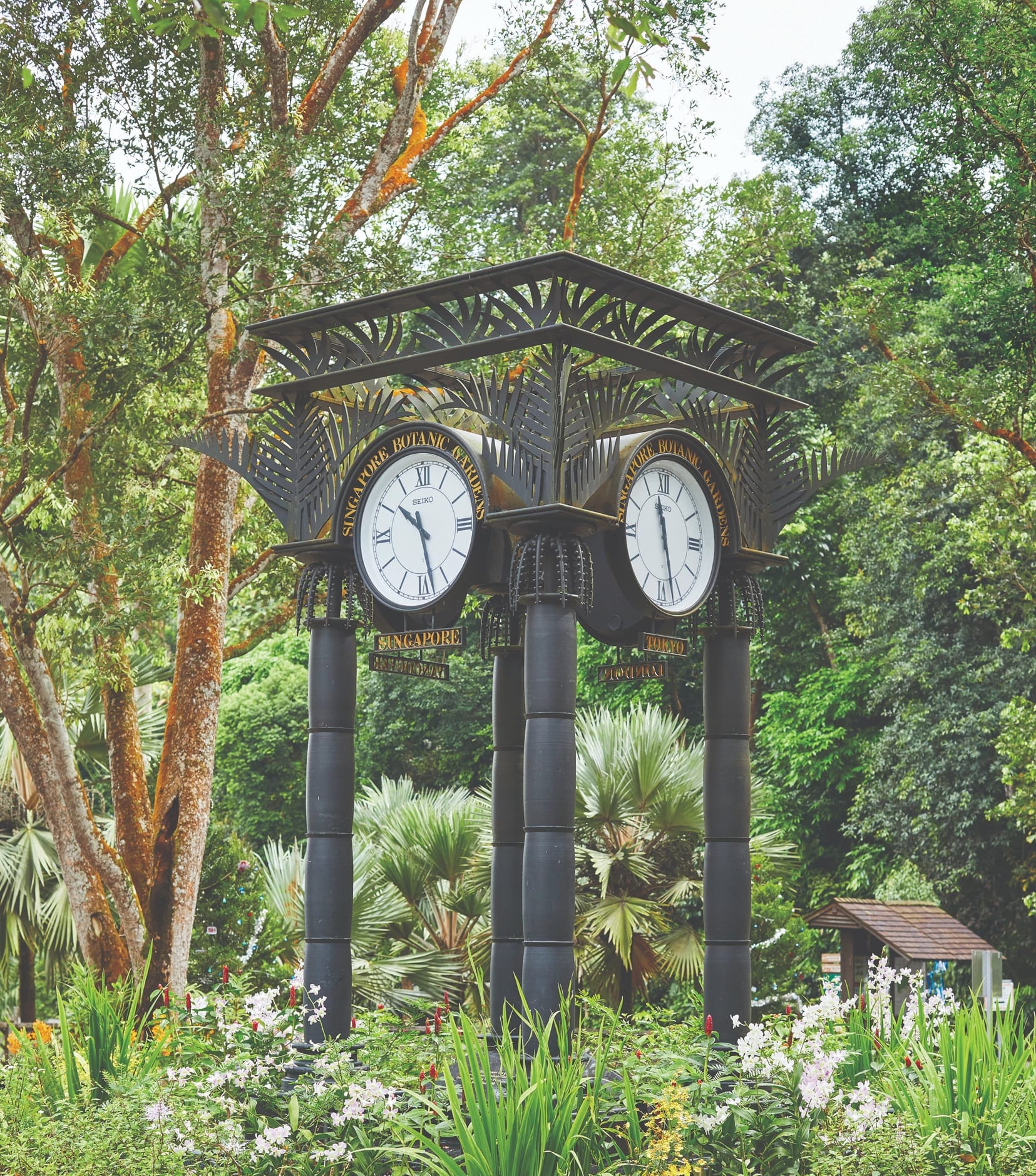
Clock Tower
ENG SIAK LOY
granite, steel
Donated by Lady Yuen Peng McNeice, 1998
Located at Orchid Plaza
Made of steel, the Clock Tower stands 3.5 m tall, with a 0.7-m-tall granite base. It was designed by Eng Siak Loy, who took inspiration from the Sealing Wax Palm (Cyrtostachys renda) found in the Gardens’ logo. The tower was originally placed at the Nassim Gate Visitor Centre, but was moved to Orchid Plaza in 2014, where it has become an iconic landmark. The Clock Tower was commissioned by Lady McNeice, a longstanding patron of the Gardens.
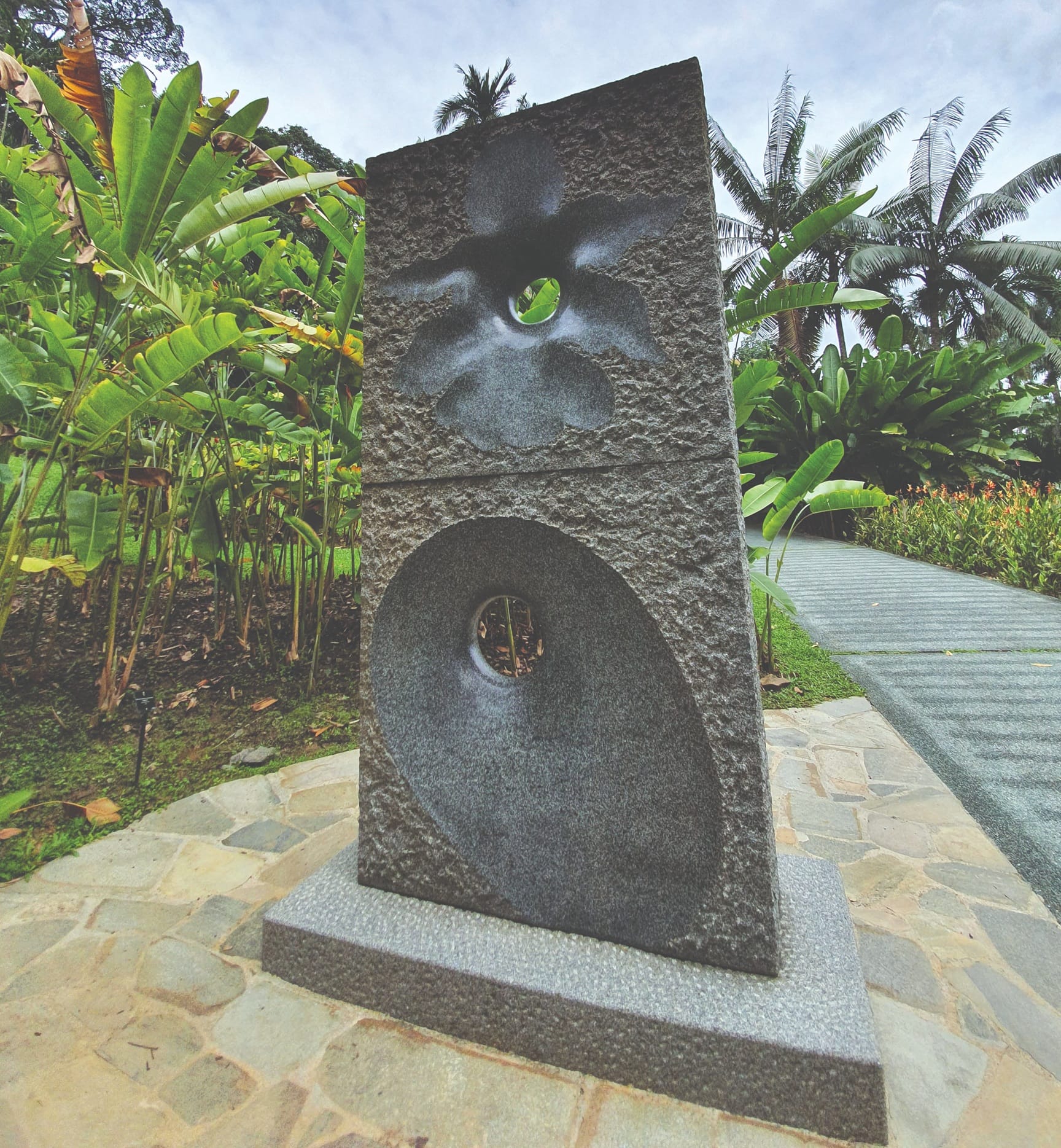
Conversation-From Nature
LEE SOO HONG
granite
Donated by the Embassy of the Republic of Korea in Singapore,
with support from Matthew Baik Manjooran, 2011
Located along Heliconia Walk
Conversation–From Nature features engravings of the Rose of Sharon (Hibiscus syriacus) and the Vanda Miss Joaquim (Papilionanthe Miss Joaquim), the respective national flowers of the Republics of Korea and Singapore. Placed together, the two floral images spring from the same centre, symbolising the interconnectedness and friendship between the two countries. Inspired by the theme of symbiosis between man and nature, the piece also underscores the important role that individuals play in maintaining balance and true harmony with nature. The circle that sits in the centre of both flowers symbolises not only communication between the two countries, but also the conversations that human beings have with nature, with the circle representing the source of conversation, sound.
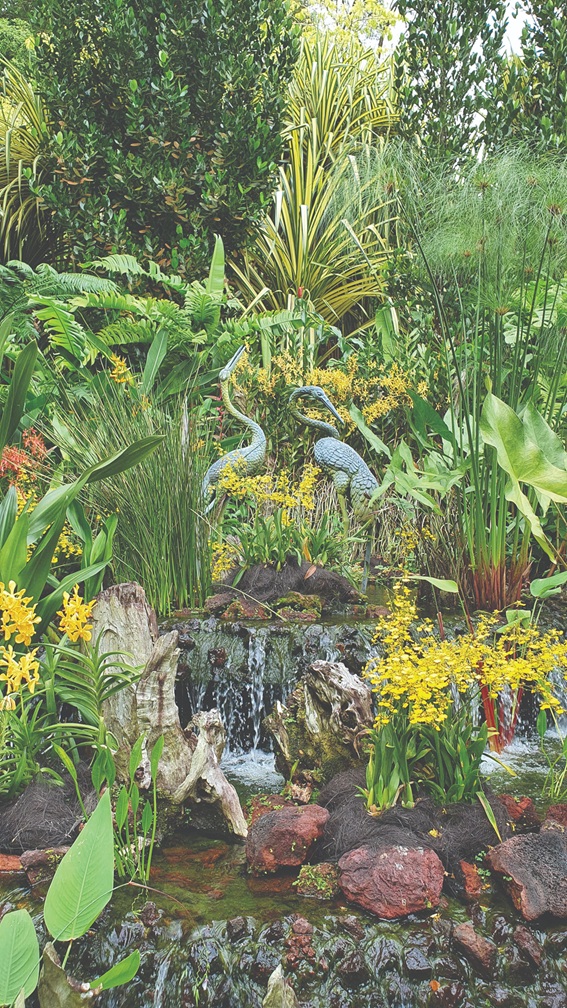
Cranes
UNKNOWN ARTIST
bronze
Donated by Tan Hoon Siang, 1995
Located in the Crane Fountain, National Orchid Garden
These elegant cranes were donated by Tan Hoon Siang as a congratulatory gift for the opening of the National Orchid Garden. Surrounded by beautiful orchids, the sculpture stands at the entrance to the Garden, welcoming and wishing all visitors good health and longevity.
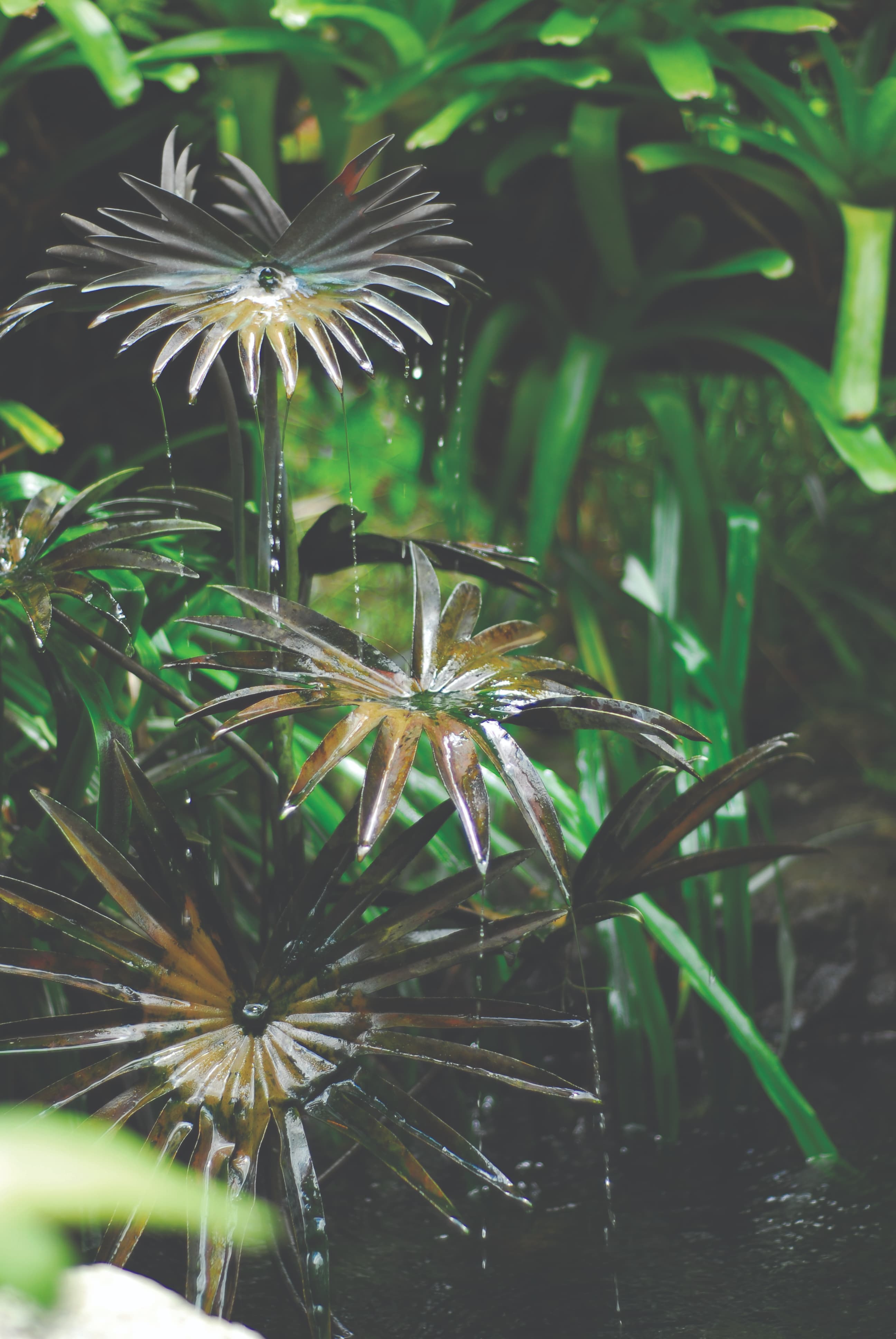
Fan Palm Fountain
GARTH BOWDEN
copper brazed with silver/copper alloy
Donated by Lady Yuen Peng McNeice, 2000
Located in the National Orchid Garden
The Fan Palm Fountain was designed by Garth Bowden, an artist in his own right who also happens to be the son of well-known English fountain designer Dr Humphrey Bowden. The sculptural fan palm here is almost an extension of his father’s Farfugium Fountain, blending perfectly with the surrounding foliage while water trickles down from the narrow tips of the leaves in a gentle pitter-patter.
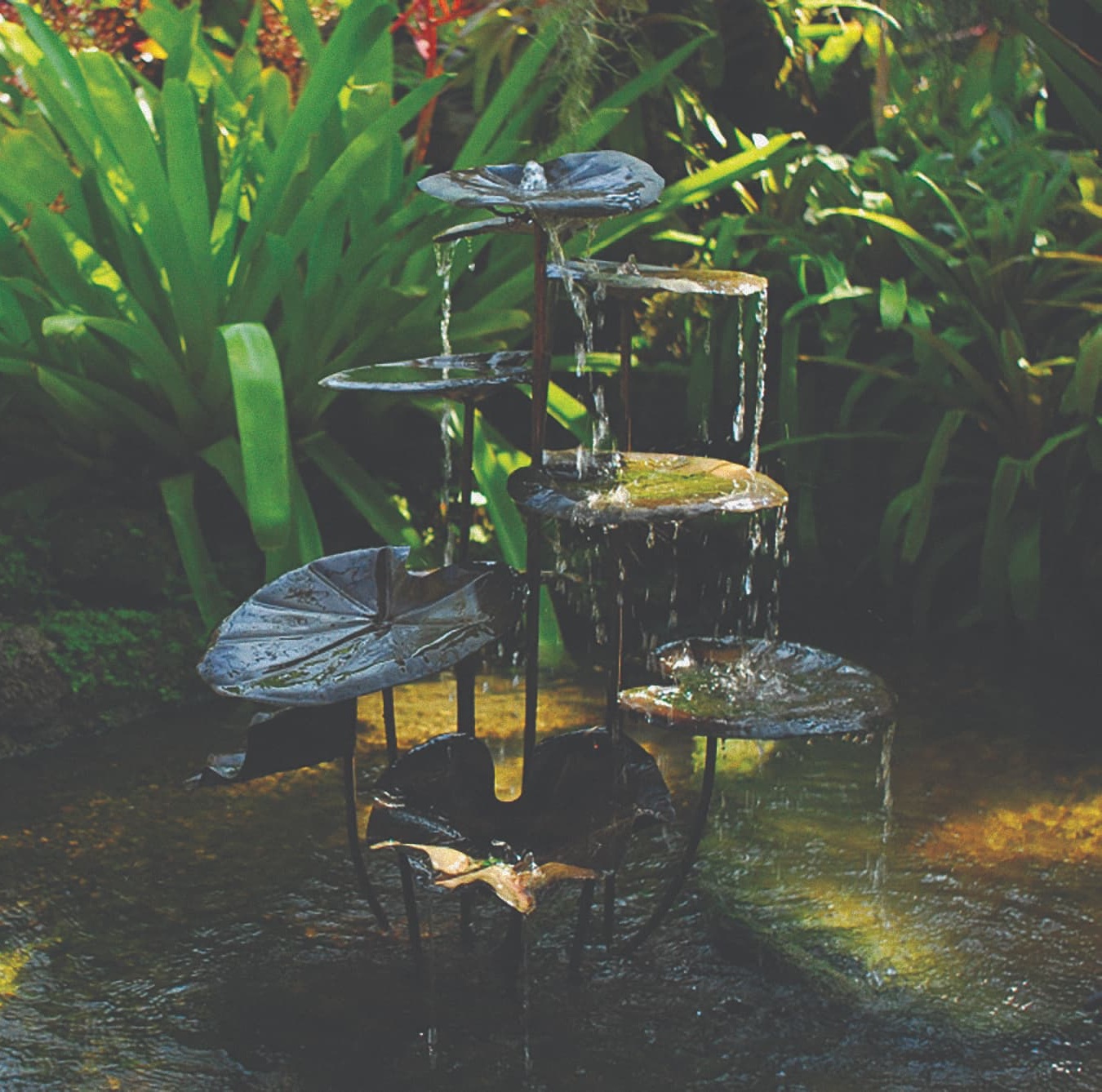
Farfugium Fountain
DR HUMPHREY BOWDEN
copper
Donated by Lady Yuen Peng McNeice, 2000
Located in the National Orchid Garden
Designed and sculpted by Dr Humphrey Bowden, the Farfugium Fountain was commissioned as a gift for the Gardens. Inspired by the plant Farfugium japonicum, the design features scalloped, rounded copper leaves on slender stalks.
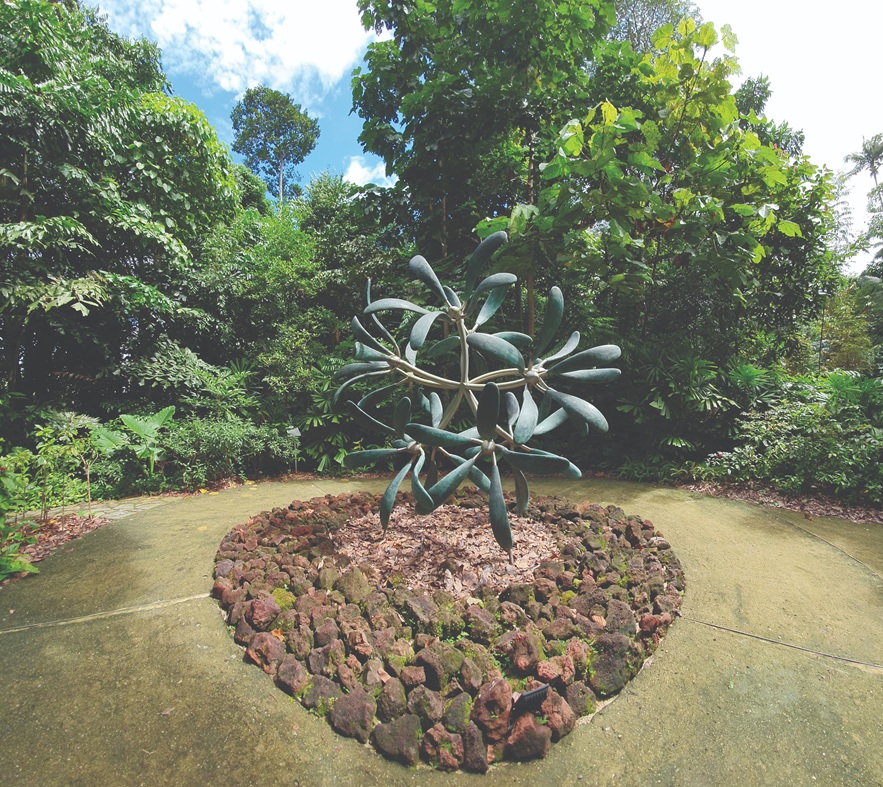
Fifty Wings
JAMES SURLS
bronze, stainless steel
Donated by Dr Helmut and Anna Sohmen, 2015
Located at the southeast entrance to the Rain Forest
Fifty Wings was donated by Helmut and Anna Sohmen in 2015, to commemorate the 50th anniversary of Singapore’s independence. It was inspired by the winged fruits of the dipterocarp trees found in the Gardens, and features 50 ‘wings’, representing Singapore’s 50 years of independence. Trees in the dipterocarp family, Dipterocarpaceae, are dominant species in many rainforests of Southeast Asia. Sadly, many of these are threatened by deforestation.
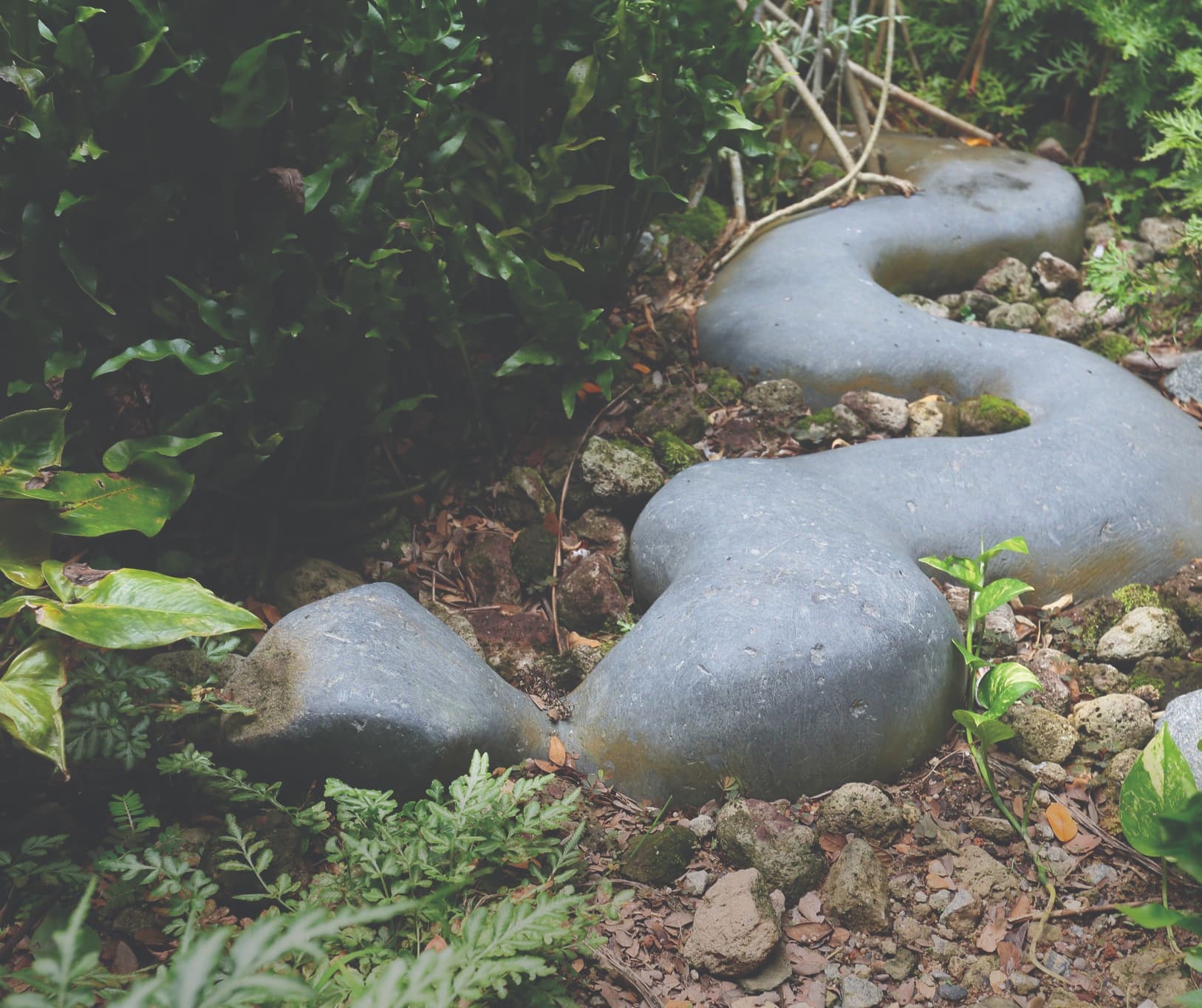
Gaboon Viper
DOMINIC BENHURA
springstone
Installed in 1996
Located at the Nassim Gate Visitor Centre
The Gaboon Viper depicted in this artwork is known to be one of the deadliest snakes in Africa, made from a single large piece of hard springstone.
The idea for this piece came to the sculptor during a period of personal difficulty, when he wanted to create something aggressive to personify his negative feelings. He described the process of creating the Gaboon Viper as intense.
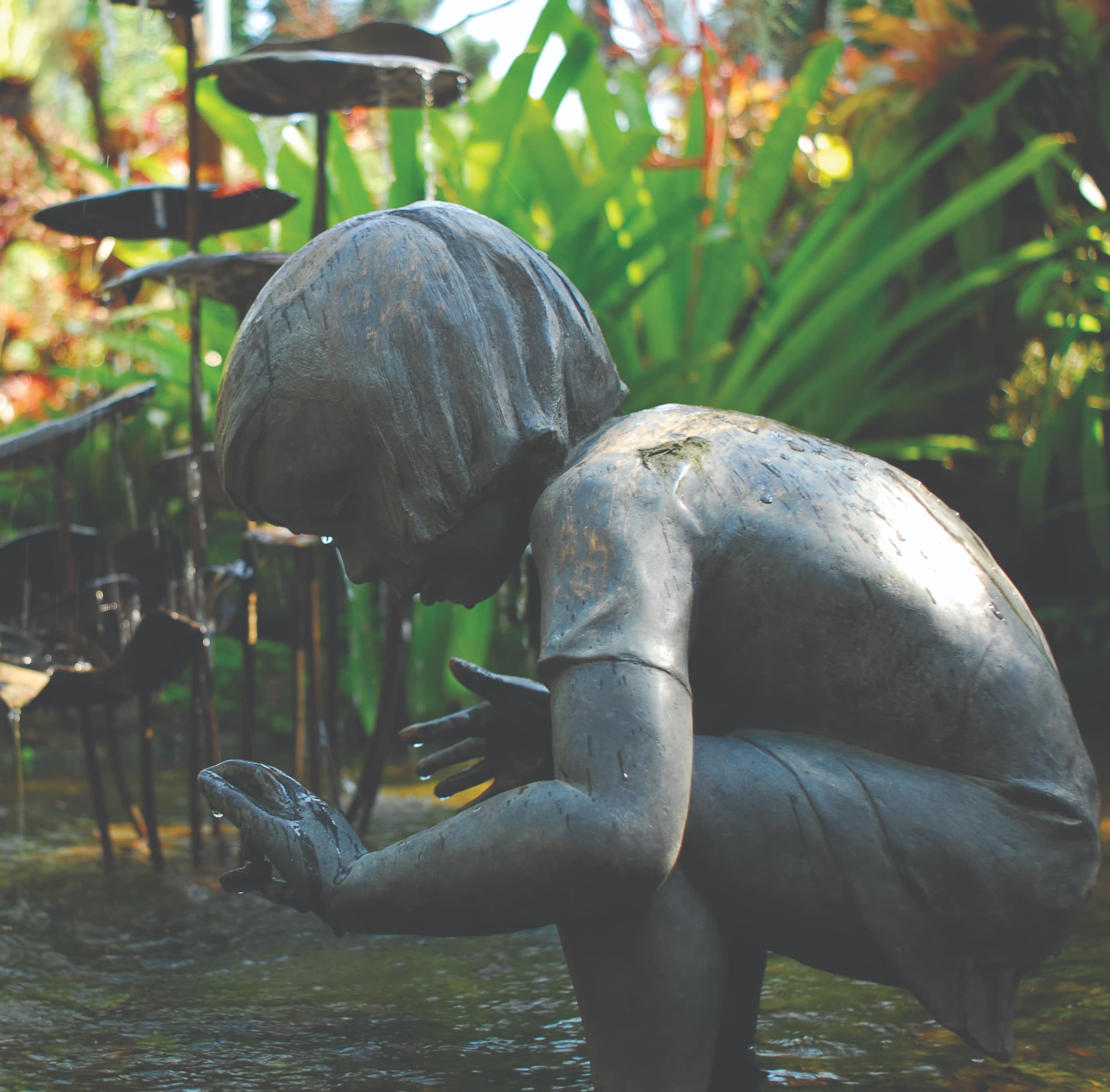
Little Girl with Shell
VANESSA MARSTON
bronze
Donated by Lady Yuen Peng McNeice, 2001
Located in the National Orchid Garden
This sculpture depicts a little girl taking a very close look at a shell that she has found. The piece encapsulates the natural curiosity that children have with nature. Visitors who spot her in the National Orchid Garden are sure to be delighted.
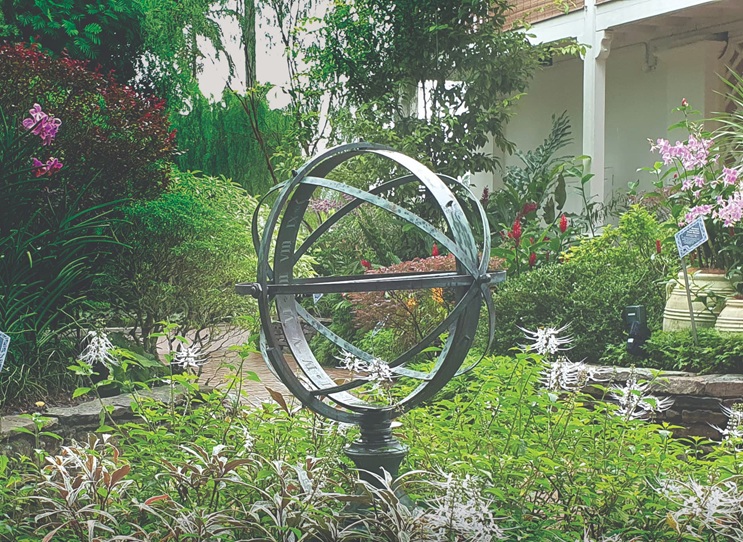
Sundials at National Orchid Garden
WESTWOOD DIALS
bronze
Donated by Mdm Looi Eng San, 1995
Located in the National Orchid Garden
This pair of intertwining sundials was donated by Mdm Looi Eng San in 1995, as a congratulatory gift for the opening of the National Orchid Garden. They were made by John Close, a bespoke sundial maker based in the UK, whose company went by the name of Westwood Dials at the time.
Bukit Timah Core
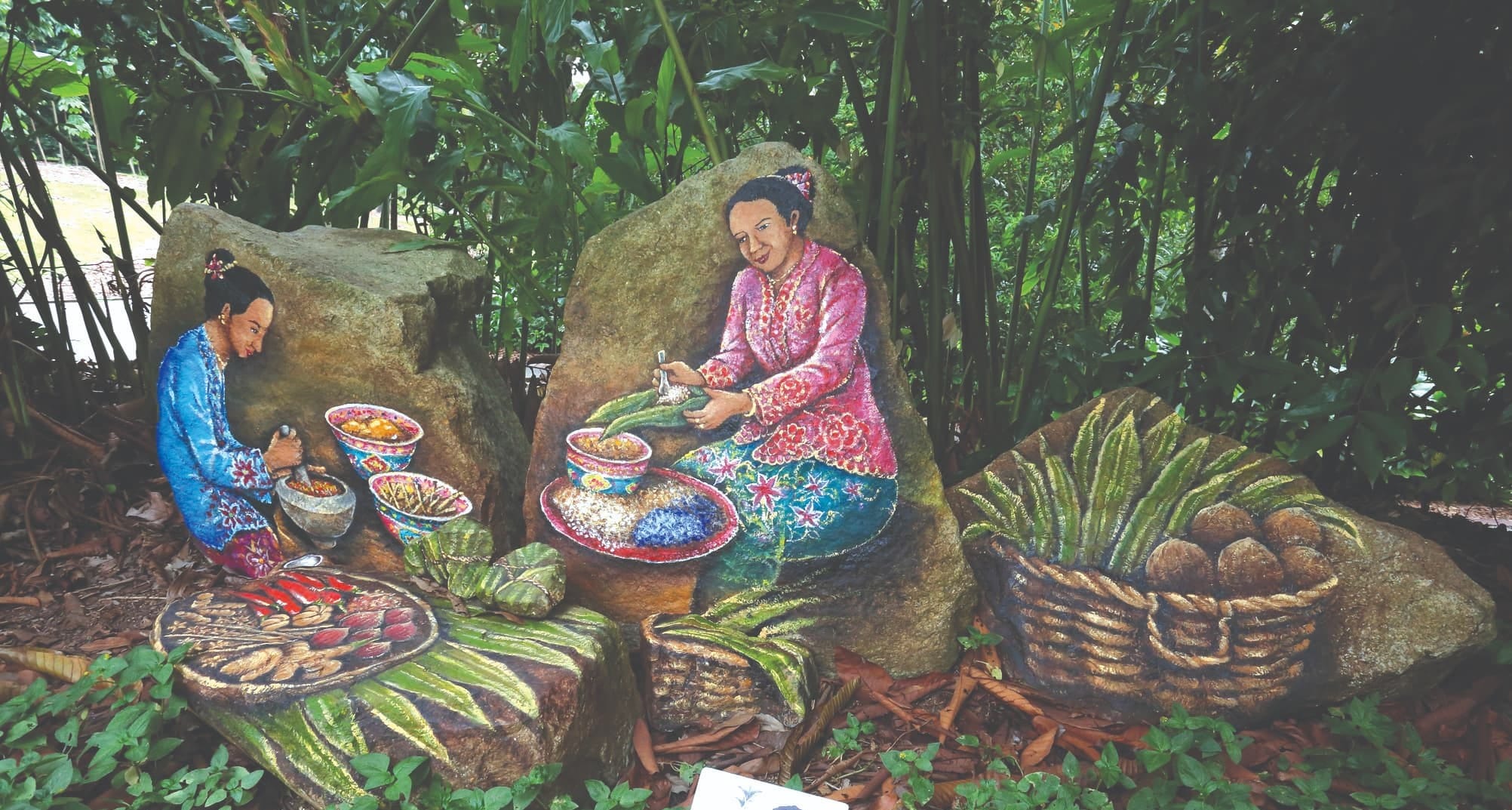
Ethnobotany Stone Murals
YIP YEW CHONG
paint on rock
Donated by Serene Koh, 2018
Located in the Ethnobotany Garden
Four painted rock murals showcase the different ethnobotanical uses of plants in the everyday lives of various cultures in the region. They were painted on-site by Yip Yew Chong, a Singaporean artist well-known in the local street art scene. The unique medium of paint on rock was chosen for the ability to withstand exposure to the elements. It was agreed that once the murals have weathered beyond recognition, nature could reclaim the rocks.
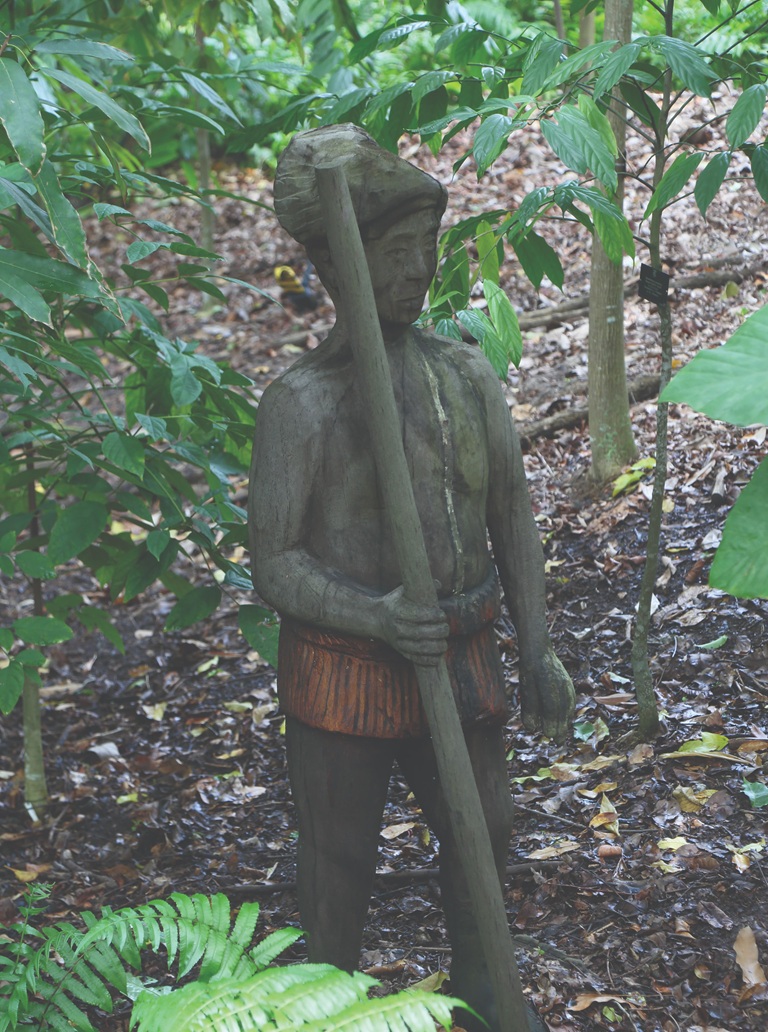
Hunter-Gatherer
AILEEN TOH
Shorea wood
Installed in 2018
Located in the Ethnobotany Garden
These two sculptures located in the Ethnobotany Garden were created by Aileen Toh from the Singapore Sculpture Society. They are sculpted from the wood of salvaged Shorea logs from within the Gardens, and depict Orang Asli, or ‘native people’ in Malay, the indigenous people of Peninsular Malaysia. One sculpture depicts a life-sized figure holding a long stick for defense in his right hand. The other is a hunter poised with a 1.5-m-long blowpipe at his mouth, ready to fire a poison dart at his target. Next to the hunter is an Antiaris toxicaria tree, a native species which the Orang Asli utilise as a source of poison.
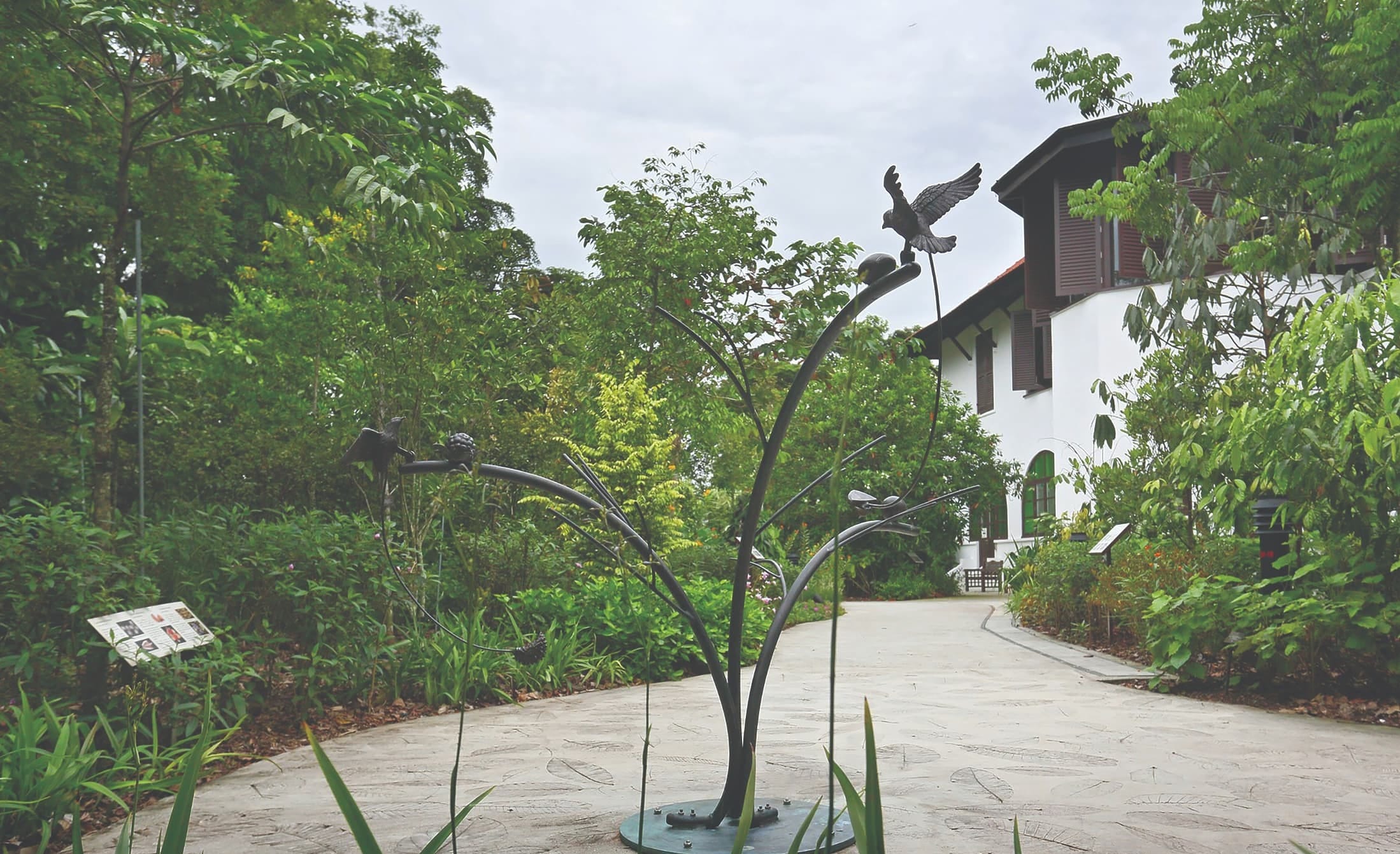
Interactive Birds
CHUA BOON KEE
brass
Installed in 2019
Located in the Seed Dispersal Garden
This fourth brass sculpture by Chua Boon Kee illustrates seed dispersal by animals, also known as zoochory. It depicts three bird species feeding on the seeds of three different plant species – the Orange-bellied Flowerpecker (Dicaeum trigonostigma) and the Broad-leaf Bramble (Rubus moluccanus); the Red-crowned Barbet (Megalaima rafflesii) and the Queen Coralbead (Cocculus orbiculatus); and the Pink-necked Green Pigeon (Treron vernans) and the Green Coffee tree (Canthiumera robusta).
Javan Cucumber Seed
CHUA BOON KEE
brass
Installed in 2019
Located in the Seed Dispersal Garden
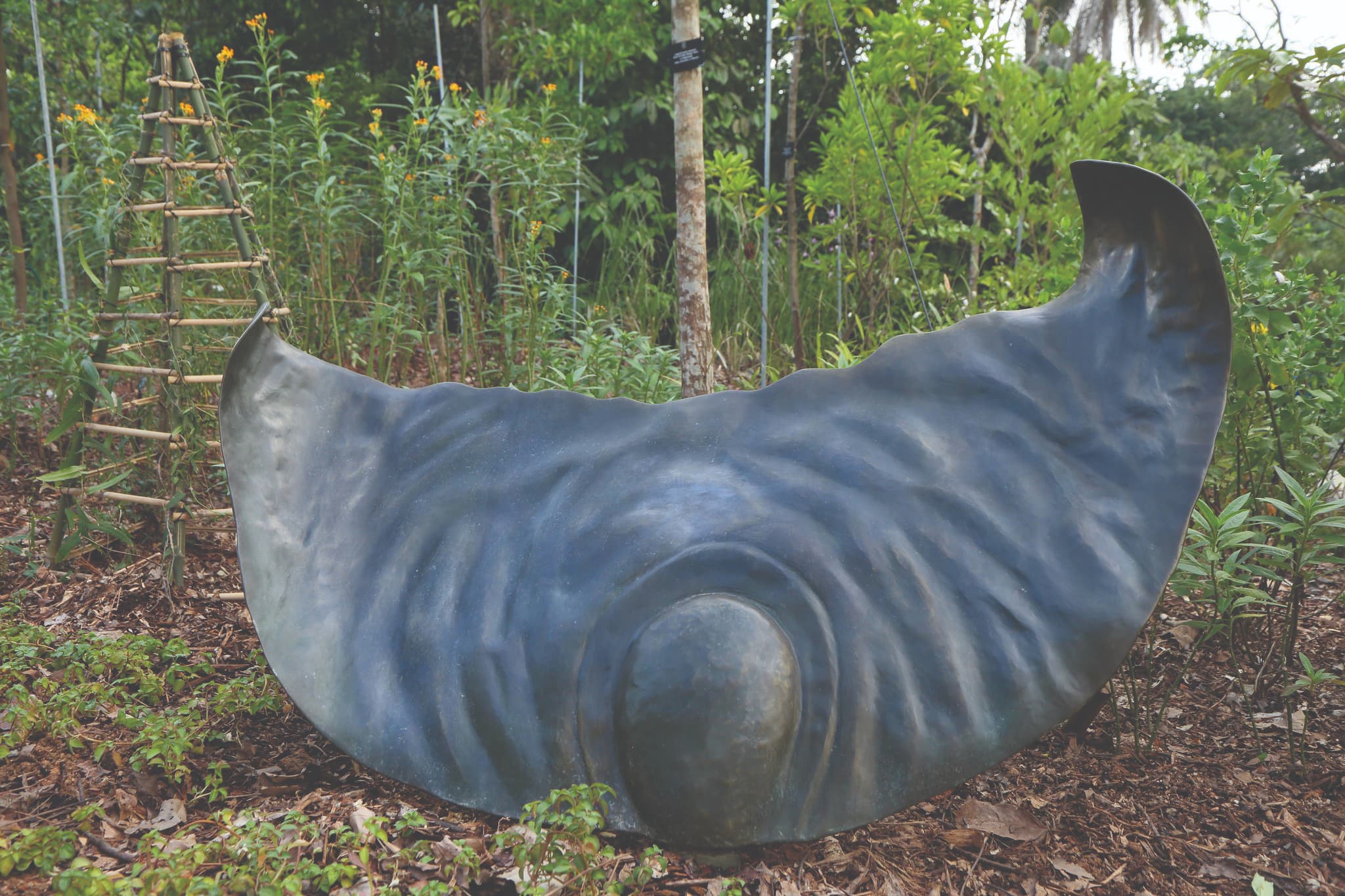
This brass sculpture showcases a seed of the Javan Cucumber (Alsomitra macrocarpa). This is a climbing species that produces a football-sized fruit known as a pepo. Inside the fruit are hundreds of winged seeds tightly packed together. Each seed is only 1 mm thick, and light enough to glide through the air for hundreds of metres, making the Javan Cucumber an example of a species that disperses its seeds via wind, also known as anemochory.
Mystree
ZADOK BEN-DAVID
corten steel
Donated by Dr Rosslyn Leong, 2007
Located at the entrance to the Jacob Ballas Children’s Garden
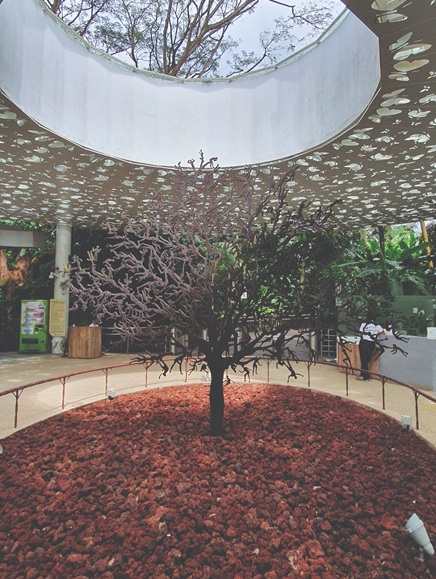
Mystree is a captivating tree-like sculpture comprising over 500 small human figures. Located at the entrance of the Jacob Ballas Children’s Garden, it was gifted by Dr Rosslyn Leong for its opening in 2007. The London-based sculptor Zadok Ben-David created Mystree from corten steel, which weathers upon exposure to the elements to give a rusty-red appearance. The design is reflective of the theme of the Jacob Ballas Children’s Garden – life on Earth depends on plants.
Native Wildlife
ENG SIAK LOY and WENG ZIYAN
copper
Donated by Dr Rosslyn Leong, 2017
Located in the Jacob Ballas Children’s Garden
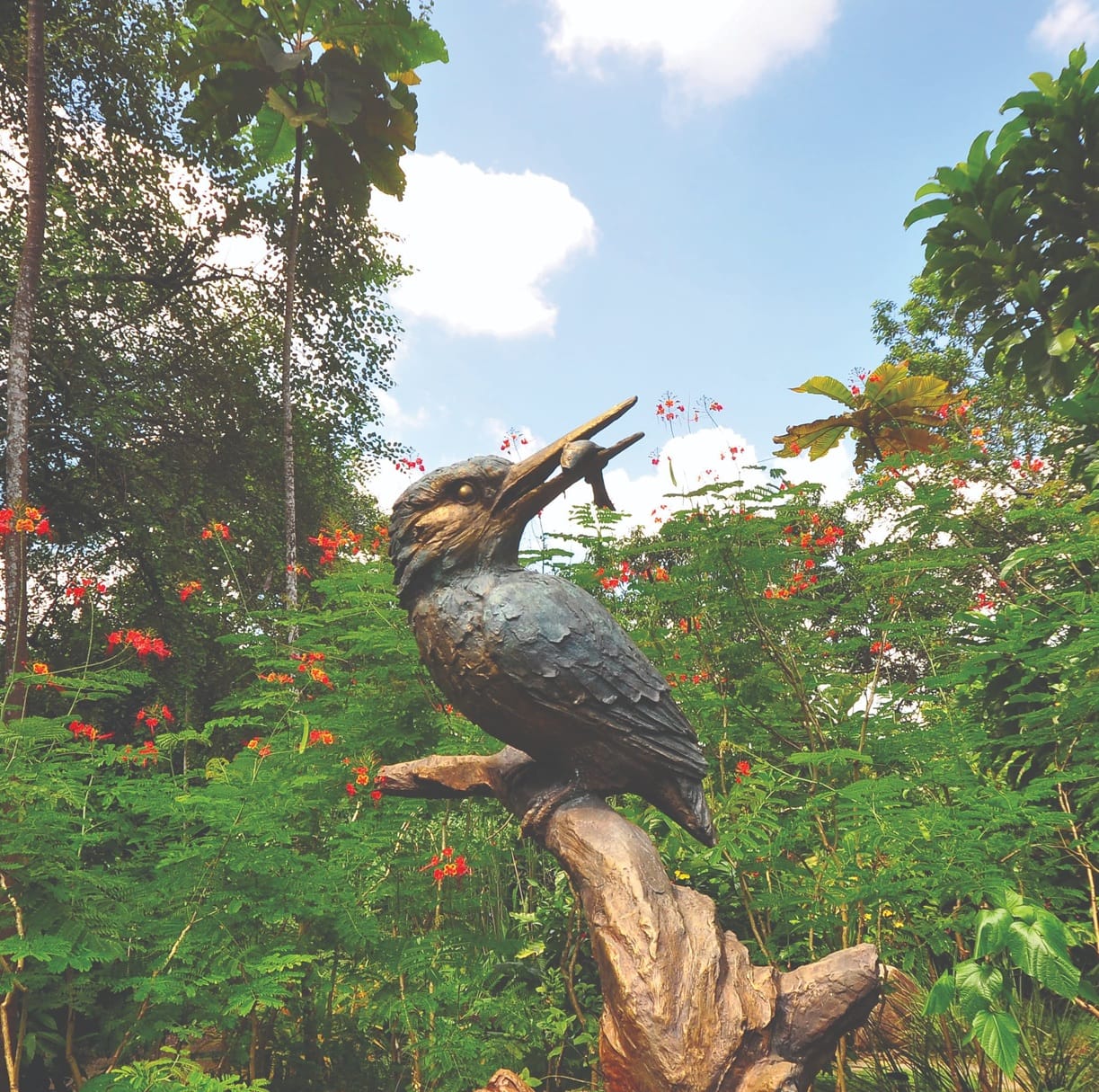
Native Wildlife is a collection of three copper sculptures located within the new extension of the Jacob Ballas Children’s Garden. Large and placed low to the ground, they are tactile pieces that stimulate children’s exploration of the natural world. The first sculpture is in a zone featuring a stream and depicts a Common Kingfisher (Alcedo atthis) sitting on a tree stump. The second sculpture is found in an orchard themed zone and features a Common Flameback (Dinopium javanense) perched on a Jackfruit tree (Artocarpus heterophyllus). The third sculpture is found in a farm themed zone and showcases a Common Rose butterfly (Pachliopta aristolochiae) visiting a flower of the Common Sendudok (Melastoma malabathricum).
Saga Daun Tajan Seeds
CHUA BOON KEE
brass
Installed in 2019
Located in the Seed Dispersal Garden
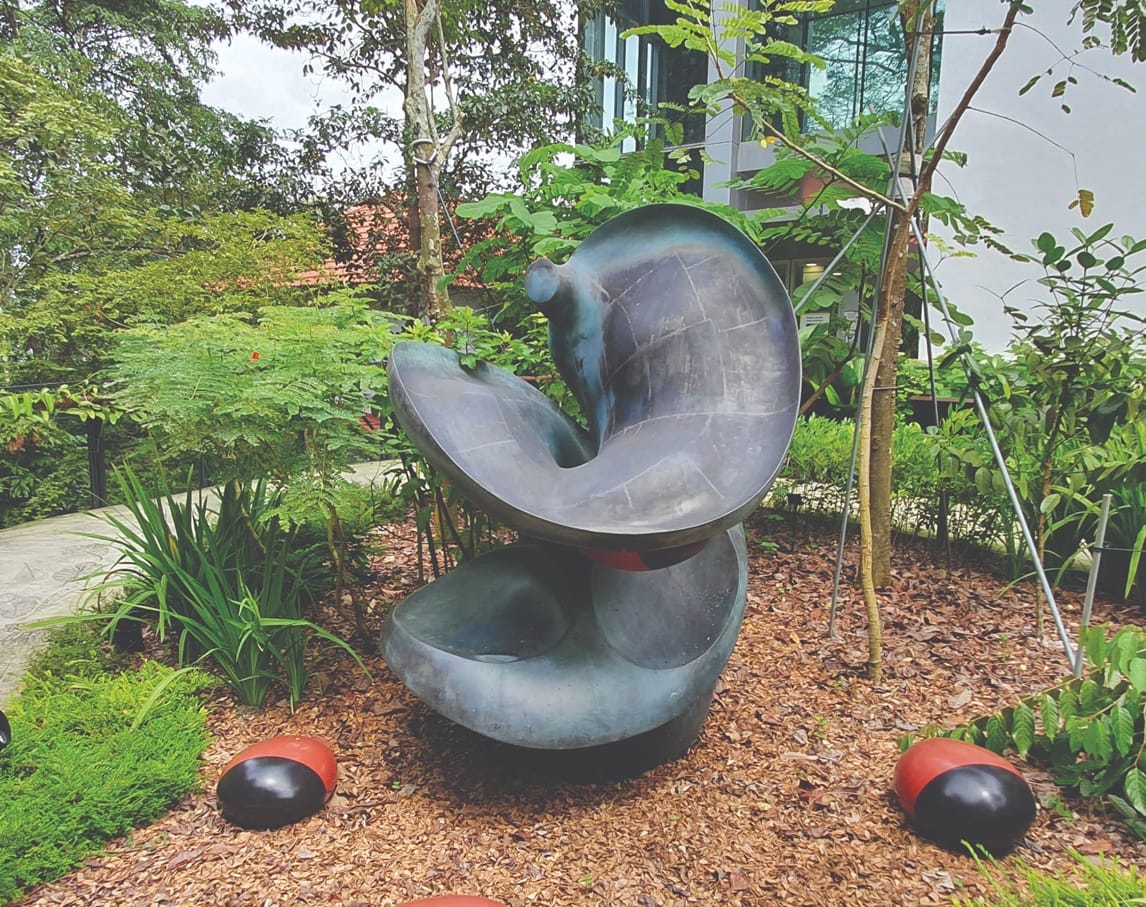
This sculpture depicts a seedpod and seeds of the Saga Daun Tajam (Adenanthera malayana), a species which disperses its seeds via autochory, or self-dispersal. The long seedpods twist spirally as they mature, eventually splitting open to release glossy red and black seeds.
Sea Pong-Pong Seeds
CHUA BOON KEE
brass
Installed in 2019
Located in the Seed Dispersal Garden
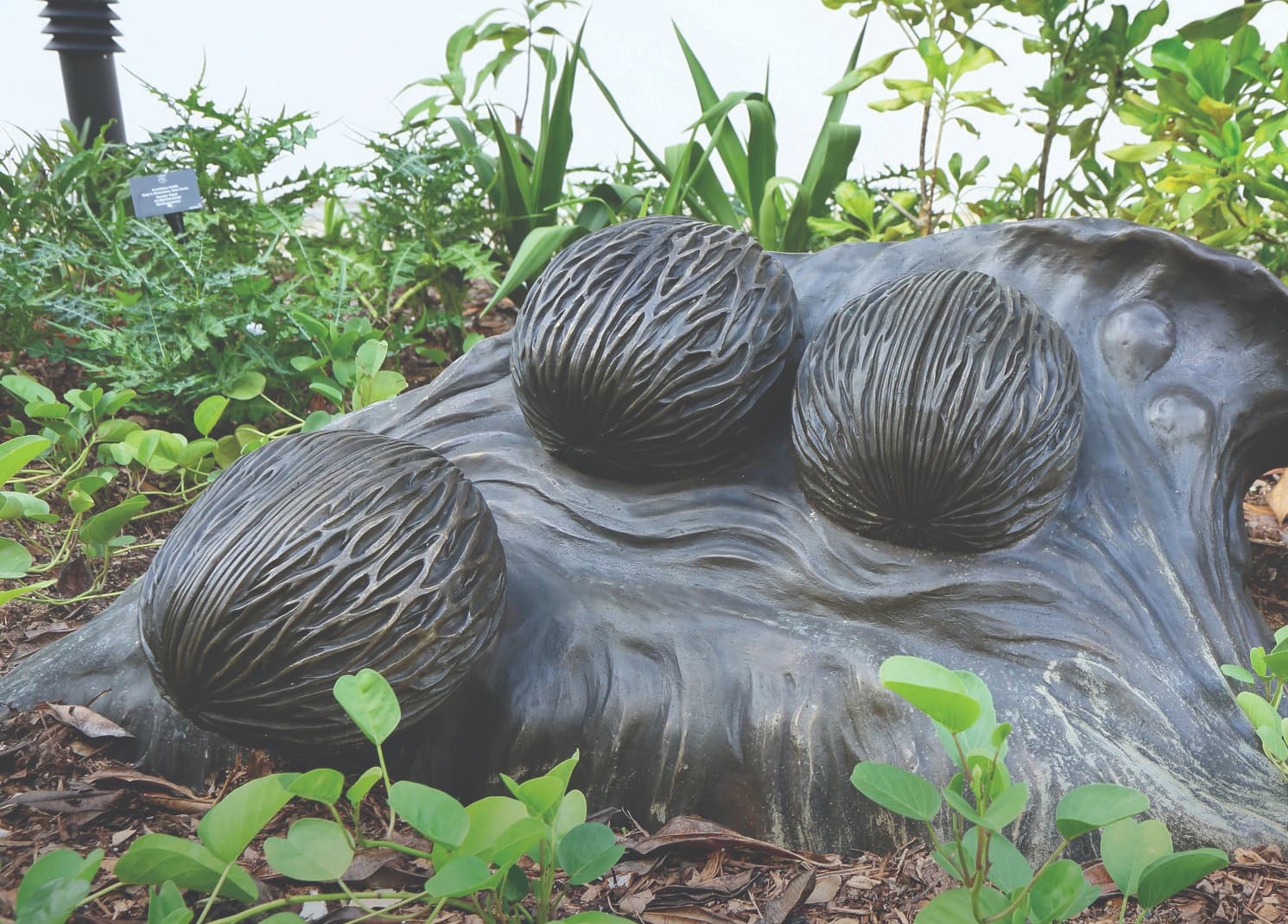
This sculpture depicts the seeds of the Sea Pong-pong (Cerbera manghas). An example of a water-dispersed species, the fruit has an exocarp that disintegrates to reveal a thick, fibrous mesocarp, which helps the seed stay afloat and travel long distances on water. The seed is surrounded by a waterproof seed coat, or endocarp, that protects it during prolonged exposure to saltwater. Another term for dispersal via water is hydrochory.
Tandok-Tandok Seeds
CHUA BOON KEE
brass
Installed in 2019
Located at the entrance to the Seed Bank
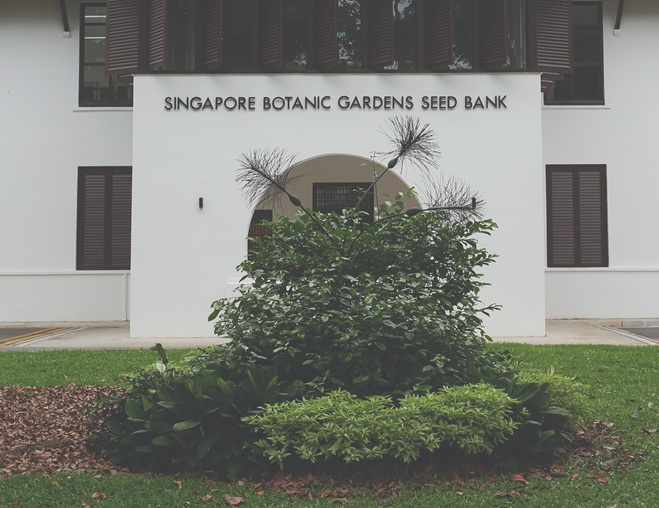
This sculpture of three Tandok-Tandok (Strophanthus caudatus) seeds stands at the entrance of the Seed Bank. Made from brass, its brown patina forms a striking contrast against the white colonial-style building it fronts. Several species of Strophanthus are planted around the sculpture, including Strophanthus caudatus. This native and critically endangered climber has beautiful white star-shaped flowers, with each petal extending into a long red tendril-like tip.